A New York minute: game, set, Rolex
Square Mile · Mark Hedley · 2026-08-18T11:22:21+00:00 · nguồn gốc
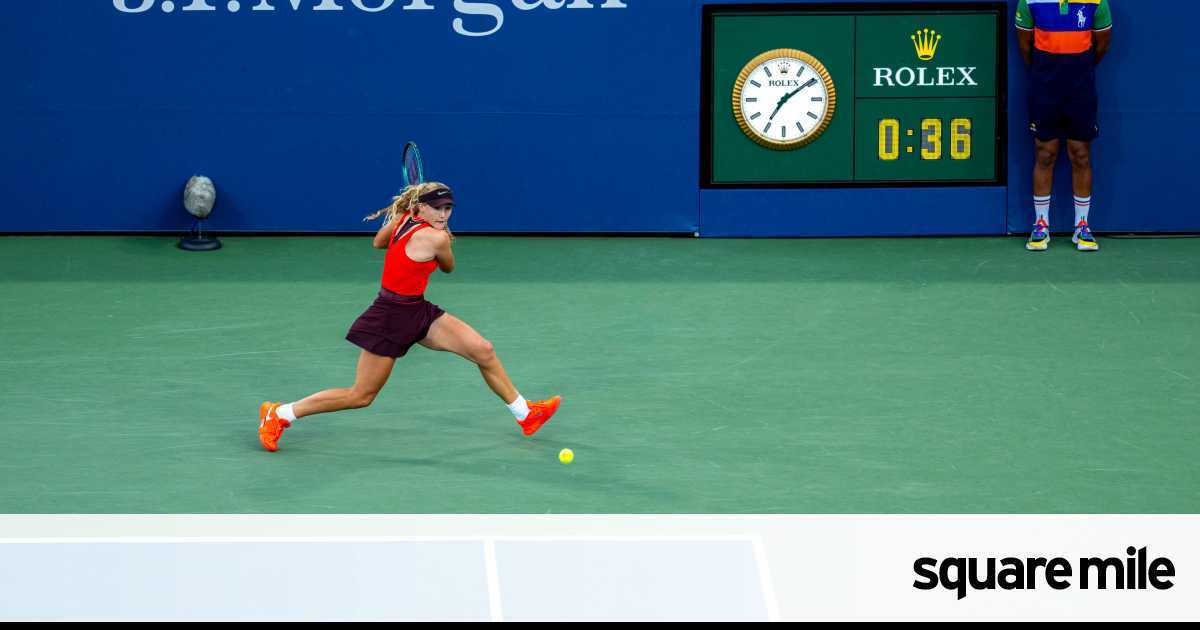
There is a particular moment during an evening session at the US Open when the sun has disappeared behind the Manhattan skyline, the floodlights are burning above Arthur Ashe Stadium, and more than 20,000 spectators collectively decide that tennis should sound more like a prize fight.
For the player standing alone at the baseline, preparing to serve at match point, the effect must be extraordinary. A fraction of a second is all it takes to win a match that may have already lasted more than five hours.
Time has always played a curious role in tennis. Unlike most major sports, a match is not governed by a clock. There is no final whistle to rescue a player protecting a lead, no possibility of running down the remaining minutes. You simply have to win the last point. (Plus, all the others needed to get into that position in the first place. But you know what we mean.)
It makes the US Open an appropriate stage for Rolex, a brand whose relationship with tennis now stretches back almost half a century.
If there is a particularly important tennis ball being hit somewhere in the world, there is a decent chance a Rolex clock is watching over proceedings
The partnership with the sport began in 1978, when Rolex became Official Timekeeper of The Championships, Wimbledon. Tennis was changing rapidly, expanding beyond its traditional audience and creating a new generation of genuinely global stars. Rolex has remained alongside it ever since.
Today, the Crown is the Official Timekeeper of all four Grand Slam tournaments, as well as the ATP and WTA and some of the most significant events on both tours. Its involvement encompasses all nine ATP Masters 1000 tournaments and all ten WTA 1000 events, alongside the Nitto ATP Finals, WTA Finals and leading team competitions. In other words, if there is a particularly important tennis ball being hit somewhere in the world, there is a decent chance a Rolex clock is watching over proceedings.
Yet its relationship with the US Open feels particularly apt because, for all the heritage surrounding the tournament, New York has rarely been afraid of change.
The US Open introduced the tie-break to Grand Slam tennis in 1970. Three years later, it became the first of the four majors to award equal prize money to men and women – the culmination of a campaign in which Billie Jean King played a defining role. In 1975 came another innovation that now seems inseparable from the tournament: night tennis.
Then, in 1978, the tournament left the West Side Tennis Club in Forest Hills and moved to what is now the USTA Billie Jean King National Tennis Center at Flushing Meadows.
Tennis had swapped the leafy confines of a private club in Queens for a vast new sporting complex next to the site of the 1964 World’s Fair. Having begun life on grass and subsequently switched to green clay, the US Open became the first Grand Slam tournament to be played on hard courts.
Waiting for it there was Chris Evert. The defending champion and Rolex Testimonee had already won the previous three US Opens, twice on clay and once on the Forest Hills grass.
A new venue and a new surface did little to disrupt her flow. Evert won the tournament without dropping a set, securing a fourth consecutive title. So much for needing time to settle in.
It is easy to see why Rolex found a natural partner in her. Evert would eventually accumulate 18 Grand Slam singles titles, but her longevity was built on something more interesting than simply winning: the ability to adapt.
UPI/Bettmann Archive/Getty Images
Rolex
“The fact that I won on hard courts three times despite it not really being my surface is something I am really proud of,” she says. “It shows I was able to learn new shots, to improvise and be more flexible on different surfaces.”
There is another element to Rolex’s relationship with tennis that separates it from the typical cycle of sports sponsorship. Its Testimonees tend not to disappear when their playing careers end.
Evert remains part of a lineage that includes Rod Laver, Björn Borg and Roger Federer – champions belonging to entirely different generations but connected by their influence on the game.
Federer, in particular, became almost synonymous with the partnership during a career in which he became the first male player to win 20 Grand Slam singles titles. If ever a man appeared genetically engineered to wear a Rolex while lifting a silver trophy, it was probably him.
“I love the loyalty that they have to the legends of the game like Rod Laver, Roger Federer, Björn Borg and myself,” says Evert. “Rolex hasn’t forgotten who was there during the early years, who was there to pave the way for current and future generations.”
And the next generation is arriving rather quickly.
Injury may prevent Carlos Alcaraz returning to Flushing Meadows to defend his crown, but other members of the Rolex family will be there – including Coco Gauff, Iga Świątek, Taylor Fritz and Ben Shelton – ensuring the watchmaker is represented by some of the most compelling figures in both the men’s and women’s game.
Perhaps the most intriguing is João Fonseca. Still only 19, the Brazilian has enjoyed a remarkable ascent since joining the Rolex family in 2024.
Earlier this summer he announced himself emphatically at Roland-Garros, recovering from two sets down to defeat Novak Djokovic in a four-hour, 53-minute epic before beating two-time finalist Casper Ruud to reach his first Grand Slam quarter-final.
There is something fitting about Fonseca returning to New York. He won the US Open boys’ singles title here in 2023, and his combination of explosive power and visible emotion appears tailor-made for a crowd that has never considered silence an essential part of watching tennis.
“I really love the atmosphere at the US Open, and it reminds me of playing back home,” he says. “Luckily for me, there are a lot of very passionate Brazilians attending, which makes the event extra special, and I can really use the energy of the crowd.”
Jed Jacobsohn
That atmosphere will return when the 2026 US Open begins its main-draw singles competition on 30 August, culminating in the women’s final on 12 September and men’s final the following afternoon.
Whoever survives those two weeks will have earned it. New York in late summer can be brutally hot and humid. The hard courts punish the body, the crowd tests concentration and the evening sessions can stretch long into the night. There is little room to hide inside Arthur Ashe Stadium.
It is why the US Open has produced so many moments that remain fixed in tennis history – and why Rolex’s relationship with the sport has endured.
As with its involvement in golf, motor sport, sailing and exploration, the partnership is ultimately less about keeping time than what somebody chooses to do with it.
Somewhere over the next fortnight, a player will stand at the baseline in Arthur Ashe Stadium with the match resting on a handful of points. The crowd will fall silent. The Rolex clock will continue its progress.
And, for a few seconds at least, time will appear to stand still.
See more at rolex.com