How the 'Manning Bowl' launched 'Sunday Night Football' to the top of the sports world
Awful Announcing · Sam Neumann · 2026-09-10T16:05:02+00:00 · nguồn gốc
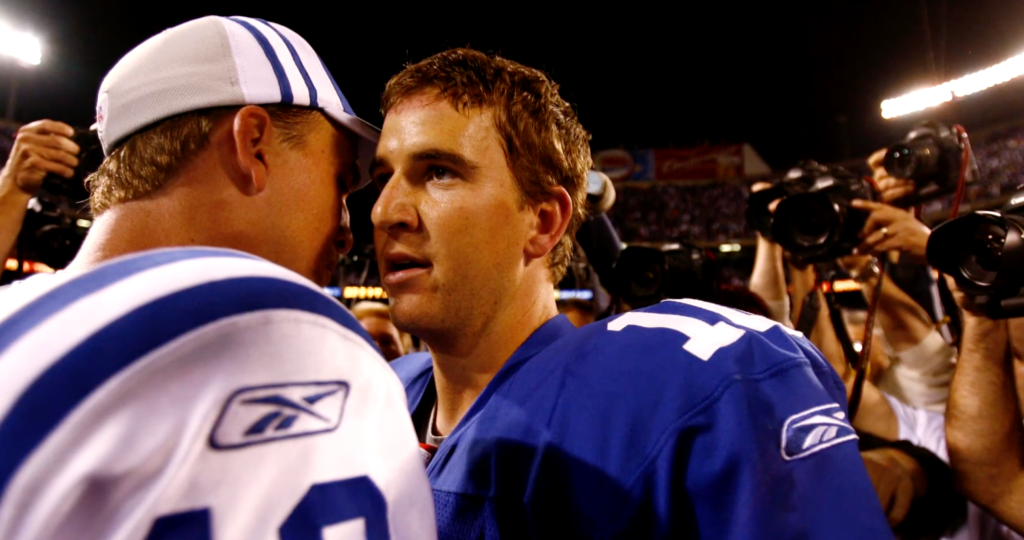
On the morning of Sept. 10, 2006, Drew Esocoff — who would go on to direct Sunday Night Football for the next two decades — found himself on a treadmill at the team hotel next to Archie Manning.
“He was as calm as any dad with sons playing QB in the NFL against each other can be,” Esocoff remembered.
That night, Archie’s sons would do something no brothers had ever done in the sport’s history: start at quarterback against each other. Peyton Manning’s Indianapolis Colts against Eli Manning’s New York Giants, in prime time, in the very first Sunday Night Football broadcast of NBC’s new deal. Twenty years later, it’s still remembered as the Manning Bowl, even if, as executive producer Fred Gaudelli found out, the Mannings themselves never called it that.
Gaudelli had just been hired to run Sunday Night Football for NBC — he says Dick Ebersol brought him aboard “literally… a couple of days before Christmas” in 2005 — when Ebersol pulled him and director Drew Esocoff aside with an unusual request: come to Torino for the Winter Olympics, families in tow, because there was work to do.
That work turned out to be building NBC’s inaugural Sunday night schedule from scratch. At around 1 a.m. Torino time, with John Madden dialing in from California, the group started plotting out kickoff games. The Pittsburgh Steelers had just won the Super Bowl. NBC needed a season-opening showcase worthy of reclaiming the NFL’s premier weekly window from Monday nights, where it had lived for decades.
“We kind of zeroed in on the Manning Bowl,” Gaudelli told Awful Announcing.
Once the matchup was set, Gaudelli went looking for material, whether it be home movies, childhood photos, anything that could humanize a storyline that was, by definition, already enormous. He called Giants PR chief Pat Hanlon, who connected him directly to Archie Manning.
Archie didn’t stop at a favor. He and his wife, Olivia, handed Gaudelli and Co. the run of the house.
“Why don’t you and the camera crew just come down here,” Archie told him, according to Gaudelli, explaining that Peyton’s and Eli’s childhood bedrooms in New Orleans were preserved exactly as the boys had left them. Gaudelli’s crew spent a full day there that June, shooting the rooms and digging through Archie’s stash of VHS tapes from the boys’ days at Newman High School.
“I really got to know Archie and Olivia, which was great,” Gaudelli said, “and still, you know, consider them friends.”
Not everything went according to plan. Gaudelli had also arranged, with the family’s blessing, to run a camera into the Mannings’ private box at Giants Stadium for the broadcast, which he promised would be used “tastefully” and sparingly.
About an hour before kickoff, someone at the stadium who wasn’t aware NBC had clearance severed the cable. There was no time to run a new one.
“All those plans went out the window,” Gaudelli said.
What NBC didn’t lose was the story itself, which the game supplied on its own. Both Manning brothers threw for big nights in a game that stayed competitive into the fourth quarter, giving Al Michaels and John Madden room to weave in family narrative without ever having to manufacture drama to fill dead air — the trap, Gaudelli said, that this kind of broadcast can fall into.
“The danger in something like that is really overdoing it,” he said. “But we didn’t, and I thought it was blended very well.”
Madden, in particular, zeroed in on an angle that’s stuck with Gaudelli for two decades. Unlike a father, who watches the game and his son at the same time, a mother watching her son play quarterback is watching him on every single snap.
“For Olivia, obviously she didn’t get a break,” Gaudelli said. “Every time the ball was in play, her son was on the field, and he was initiating the play.”
NBC opened its broadcast that night by noting that more than 12,000 games had been played in NFL history before that one — and none of them had ever put brothers against each other at starting quarterback. The Colts won, 26-21.
Gaudelli’s one regret from that night has nothing to do with production. He had hoped to get Peyton and Eli to sit down together afterward for a joint interview with sideline reporter Andrea Kraemer — a once-in-a-lifetime moment, he pitched them, and NBC would handle it carefully. 20 years later, both Mannings appear together on the ManningCast, showing their joint legacy in the sport.
Neither brother would agree to it. Only Peyton, as the winner, appeared on camera.
“I totally understood it,” Gaudelli said, “but I was hoping that maybe because this was such a unique thing, they would agree to it.”
The family, Gaudelli said, never referred to the game as the “Manning Bowl” inside their own homes — Archie included — because they felt the label diminished their teammates. NBC called it that anyway, starting with Gaudelli’s own broadcast open, and so did the rest of the sports media. The brothers met again two years later in Indianapolis, in a rematch that generated a fraction of the attention.
Gaudelli had already spent 11 years producing Sunday Night Football at ESPN in the 1990s and five more at ABC’s Monday Night Football before NBC brought the league’s marquee primetime package back to Sunday in 2006. Looking back now, he sees that first broadcast as something more than a great story that happened to fall in his lap in year one.
“It was almost like a harbinger of how special Sunday night was about to become,” he said. “The nation’s viewing habits are going to change, and Sunday night is going to be the home of where the big NFL games with the richest of storylines [are]. That’s kind of proven true over the last 20 years.”
The Manning Bowl gave way to the Brady-Manning era as Sunday Night Football’s signature attraction for its first five years on NBC. These days, Gaudelli notes, that torch has passed to Patrick Mahomes and Josh Allen, who’ll meet again on Thanksgiving night this season.
NBC opened its 21st-anniversary season Wednesday night with a Super Bowl LX rematch between the Seattle Seahawks and New England Patriots, a matchup Gaudelli said the network specifically lobbied the league for once its home schedule and travel logistics became clear.
“We wanted the Super Bowl rematch, and we certainly let the NFL know that,” he said, noting it’s only happened twice before that a Super Bowl rematch opened the following season in Week 1. From there, the schedule leans on recurring pillars of the Sunday night package: Giants-Cowboys returns to the Meadowlands in Week 1, and Packers-Cowboys — what Gaudelli calls “one of the really magical rivalries in NFL history” — is also on the docket.
“Twenty years ago, Dick Ebersol, Roger Goodell, Howard Katz — they knew they were going to have to shift the nation’s viewing habits,” Gaudelli said. “And they knew the best way to do that was with a compelling schedule. That philosophy has only grown. It’s never changed.”
As for a true Manning Bowl sequel: Peyton’s son Marshall and Arch Manning — Cooper’s son — both carry the family name into the next generation of football, with Arch now the starting quarterback at Texas. Told it wasn’t out of the question that NBC could someday host a “Cousins Manning Bowl,” you could hear Gaudelli’s ears perk up on the other end of the phone
“Sign us up for it right now,” he said.