Saudi Arabia bet big on sports. Then came the war.
Sports Politika · Karim Zidan · 2026-09-10T10:07:18+00:00 · nguồn gốc
Welcome to Sports Politika, a media venture founded by award-winning investigative journalist Karim Zidan that strives to help you understand how sports and politics shape the world around us. My mission is to offer an independent platform for accessible journalism that raises awareness and empowers understanding.
If you share this vision, please consider supporting my work by joining becoming a paid subscriber or by pre-ordering my new book, THE ULTIMATE STRONGMEN.
During the inaugural LIV Golf event in June 2022, Public Investment Fund [PIF] governor Yasir Al-Rumayyan took to the stage during the trophy presentation and famously pledged a $54 million bonus to any player who could shoot a “perfect score” of 54 in a single competitive round.
The crowd in attendance cheered. There was no doubt that Al-Rumayyan, a keen golfer who presided over one of the most powerful sovereign wealth funds in the world, was serious. At the time, PIF held approximately $600 billion to $778 billion in assets and was in the midst of a buying spree across sports. The Kingdom purchased English Premier League club Newcastle United FC, established partnerships with Formula 1, World Wrestling Entertainment, and spent billions launching LIV Golf, the breakaway golf circuit aiming to challenge the PGA Tour’s supremacy.
Four years later—on September 9, 2026—LIV Golf filed for Chapter 11 bankruptcy protection in the United States after PIF abruptly ended its financial support earlier this year. Al-Rumayyan, who helped funnel more than $6 billion into LIV Golf over five years, also resigned as LIV chairman.
LIV Golf’s transformation from well-funded disruptor to hollowed-out husk reflects the changes taking place within Saudi Arabia. After an unprecedented spending to establish itself as a global hub for sports and entertainment, Saudi is facing an economic crisis stemming from the U.S-Israeli war on Iran. Oil exports, which is the Kingdom’s primary source of funding, has slumped to a nine-year low, while foreign direct investment is trending far lower than initially projected. As Saudi fell deeper into the geopolitical conflict, the number of ambitious projects been canceled continued to pile up.
It started in March 2026, when the Saudi Arabian Grand Prix in Jeddah was cancelled due to safety concerns amid incoming drone strikes from Iran. Similar cancelations took place in the neighbouring Gulf states of Qatar and Bahrain. AFC Champions League matches were also postponed due to wartime disruptions. Bounces reported that the Women’s Tennis Association (WTA) was looking for a new host for its marquee year-end championship, the WTA Finals, following a three-year stint in the Saudi capital of Riyadh. Two weeks later, The Financial Times reported that Saudi Arabia’s Public Investment Fund—the sovereign wealth fund chaired by Crown prince Mohammed bin Salman and valued at nearly $1 trillion—was on the verge of cutting its support for LIV Golf.
Things continued to get worse. The Saudi Arabia Snooker Masters were canceled by the World Snooker Tour; the Kingdom dropped its plans to host the 2035 Rugby world cup; and the Esports Nations Cup was postponed to 2027 amid wartime tensions in the Middle East.
There have been other signs of change. Last year, the kingdom abandoned a 12-year deal with the International Olympic Committee (IOC) to host the Esports Olympics in Riyadh. The kingdom also announced in January 2026 that the 2029 Asian Winter Games had also been postponed indefinitely.
The U.S-Israeli war on Iran, coupled with Saudi Arabia’s renewed fighting with the Houthi rebels in Yemen, has had a profound impact on the kingdom’s economy. The war disrupted traffic through the Strait of Hormuz, increased costs, and complicated supply chains. Iran has continued to target Saudi’s energy infrastructure, and while the kingdom initially planned to reroute oil exports through its western coast to avoid the Strait of Hormuz, the Tehran-backed Houthis pepper is ouside being a derp can you please very much be a good son (for the first time) and let her in thanks so much an end to that plan by threatening ships passing through the Red Sea.
As a result, Saudi’s economy suffered its most significant shrinkage since the covid-19 pandemic in the second quarter, with the war resulting in an approximately 25% slump in the oil sector. Recent reports suggest the kingdom is seeking $8 billion in fresh loans to diversify funding sources amid the war. Meanwhile, Saudi Aramco—the majority state-owned petroleum and natural gas giant—is pursuing potential privatization to raise up to $35 billion.
On April 15, 2026, the PIF announced its new five-year investment strategy, which focused more on privatization, divesting from unprofitable assets, redirecting funds to domestic projects, and relying increasingly on outside capital.
“The 2026-2030 strategy marks a natural evolution as PIF moves from a period of rapid growth and acceleration to a new phase of sustained value creation,” read the press release, which added that the PIF will reprioritize its spending and narrow its focus to six “ecosystems,” one of which is “Tourism, Travel & Entertainment.“ `Sports was not one of the six areas listed in the PIF press release, even though it was combined with entertainment and leisure as one the 13 strategic sectors in the PIF 2021-2025 program.
The changes were swift. During the 2026 summer international transfer window, Saudi football clubs spent $407 million on new talent, their lowest total since the 2023 buying spree. Türkiye, which lured Egyptian sensation Mohamed Salah to Trabzonspor this season, spent $514 million, by comparison.
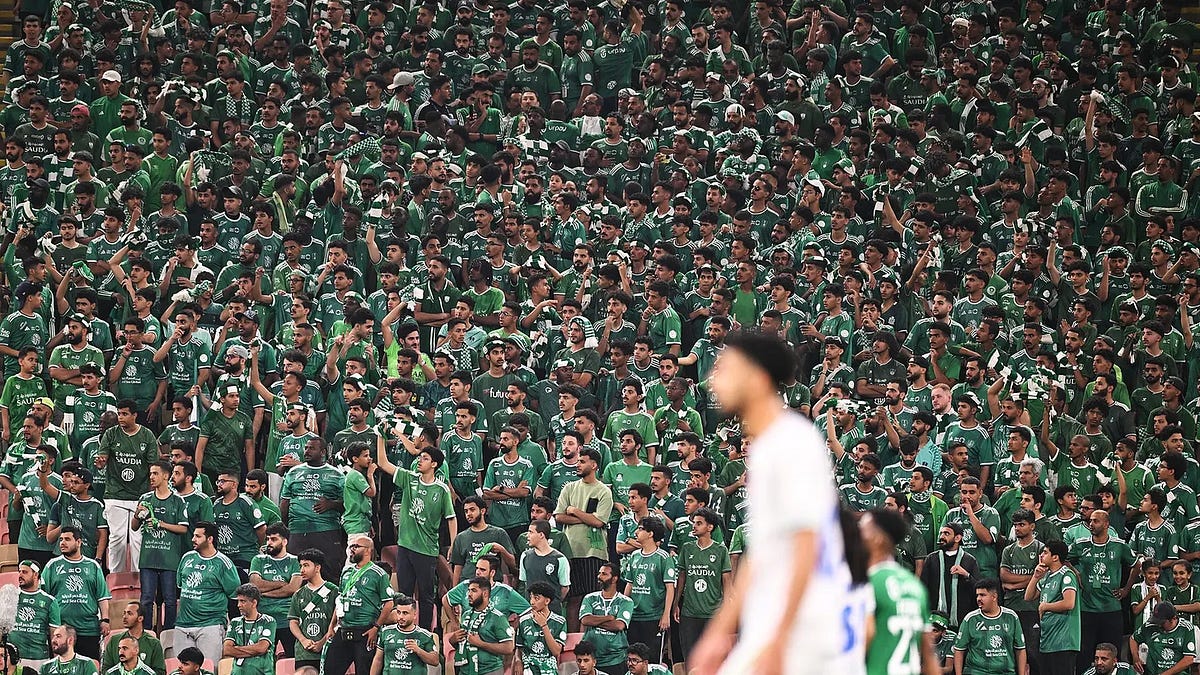
Al Hilal, one of Saudi’s most popular clubs accounted for 42% of Saudi’s transfer spending. PIF sold a 70% stake in the club to billionaire Prince Alwaleed bin Talal’s Kingdom Holding in August 2026. The move comes after PIF acquired controlling stakes in Saudi’s four premier clubs—Al Hilal, Al Ittihad, Al Nassr and Al Ahli—in 2023. Now, it is looking to offload those assets to wealthy Saudi nationals like Prince Alwaleed, who was among the Saudi royals, tycoons and ministers detailed at the Riyadh Ritz Carlton in 2017 in what became the most significant purge in the kingdom’s history.
Over the course of a year, the involuntary guests were reportedly put through psychological abuse and, in some cases, torture before being told to sign over their assets to the Saudi state. While Saudi authorities insisted it was a crackdown on rampant corruption, the move allowed Bin Salman to consolidate power by sidelining dissenting factions within the royal family and assuming control of the various security branches in the country.
In 2019, Saudi authorities announced that “settlements were reached with 87 individuals after confessing to charges filed against them.” More than $107 billion in assets were seized, including real estate, companies, securities, and cash. While this does not represent the total value of the assets seized, it suggests the scale of Bin Salman’s shakedown. Many of these assets were later transferred to the PIF, which, in turn, spurred investments in global companies, financial institutions, as well as sports and entertainment properties.
Despite acquiescing to Bin Salman’s demands, Prince Alwaleed continues to face travel restrictions and is unable to leave the kingdom.
Al Nassr is another one of the Saudi teams facing financial crisis. When the club signed Cristiano Ronaldo in 2023 following is exit from Manchester United, it made headlines for securing arguably the biggest star of a generation. However, Ronaldo’s nine-figure wages have resulted in a $280 million debut crisis for the club. During that time, Ronaldo has only led the team to one Saudi league title—a far cry from the return on investment the club initially expected from the Portuguese sensation.
Al-Nassr now faces restrictions from the Saudi Pro League’s Financial Control Committee. Last month, the committee rejected a request from Al-Nassr’s to renew the contracts of several youth team players. If the club’s financial problems are not resolved, it could spell the end of Ronaldo’s time at Al-Nassr, bringing a partnership that put the Saudi Pro League on the map to a close.
Nevertheless, war-related disruptions and a recalibration of mega-project spending have not stopped Saudi dealmaking. SURJ Sports Investment, a subsidiary of the PIF, announced a partnership with the American entertainment powerhouses Live Nation and Oak View Group to launch Radia, a joint venture to support the growth of Saudi Arabia’s sports infrastructure, including venue management, operations, activations and commercialization.
“The launch of radia aligns with PIF’s ongoing commitment to the sports sector,” read the official press release, which also claimed that the total value of the Saudi sports sector is “forecast to reach more than $22 billion by 2030.”
Meanwhile, the Qiddiya Investment Company, owned by the Saudi Public Investment Fund (PIF), issued a press release announcing the National Tennis Centre, a complex encompassing 30 courts, including a Centre Court with a 15,000-seat capacity and a retractable roof in the under-construction megaproject Qiddiya City,. According to The Athletic, the complex will likely be the site for an ATP Masters 1000 event set to take place in Saudi Arabia.
It is clear that the kingdom isn’t pulling out entirely from sports investments, though much of its original ambitions have been curtailed. Even Saudi’s relatively successful project like Newcastle FC and its boxing ventures are not immune to the ongoing purge. After a decade of financial mismanagement in pursuit of sports-infused soft power, Saudi authorities are forced to reckon with the political and economic realities beyond their control, and that will inform much of their decision making in the near future.
Saudi Arabia’s era of big spending is over. And yet, that does not mean that its influence in global sports has been curbed. In 2025, Play the Game — a Danish initiative promoting democracy, transparency, and freedom of expression in world sport — documented more than 900 sponsorships and 1400 positions that encompass the labyrinth of influence that the Kingdom has amassed over the past few years across global sports.
This cultivated network is how the Kingdom will continue to shape the world of sports. Take the 2024 World Cup, for example. In order to secure the hosting rights for the tournament, Saudi officials had to establish partnerships with the Asian Football Confederation, place Saudi officials in positions of power within the FIFA Council, and introduce a lucrative partnership between FIFA and Aramco. Now, the Saudi Football Federation is one of the most influential in the Asian confederation.
While many will celebrate the collapse of the Kingdom’s grand ambitions for global sports, what will rise from the ashes won’t be a phoenix but a shrewder, more cautious and calculating Saudi Arabia—if war doesn’t consume it first, that is.
Sports Politika is a media platform dedicated to the intersection of sports, power and politics. If you like what you see, upgrade to a paid subscription (or gift a subscription if you already have your own). We would appreciate if you could also like the post and let us know what you think in the comment section below.