The Ødegaard paradox: Can Arsenal’s controller play higher?
VAVEL.com · Lachlan Garrett; VAVEL com · 2026-09-10T01:53:11+00:00 · nguồn gốc
There are footballers who dominate matches through goals. Others do it through assists.
Then there are players like Martin Ødegaard, who somehow manage to dictate almost every meaningful moment without the ball ever seeming to belong to anyone else for very long.
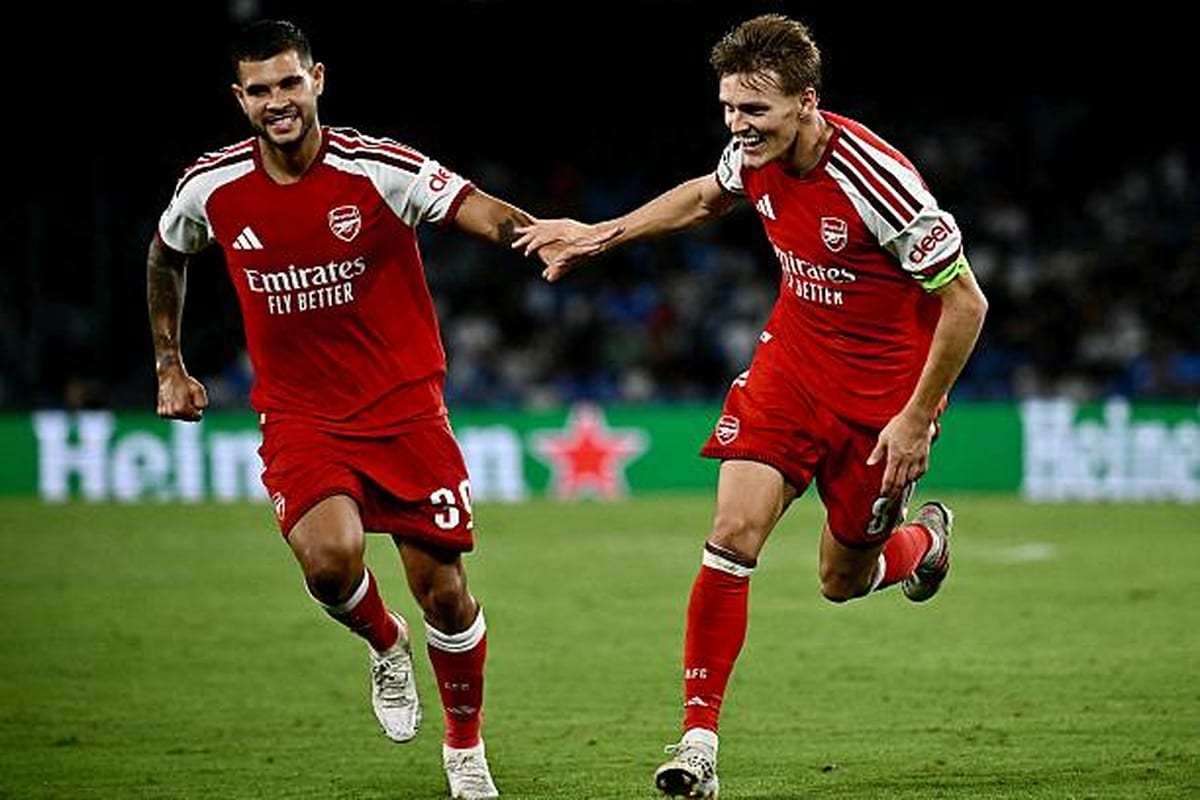
Against Napoli, Arsenal’s captain produced one of those performances that will probably be remembered for his winning goal. The reality, though, is that the finish was almost the least interesting part of his evening.
A statistic shared after the match showed Ødegaard completed 72 accurate passes in the final third, placing him alongside Xavi, Andrés Iniesta and Toni Kroos as the only players to achieve that figure in a single Champions League match since 2003/04.
That is absurd company.
It also creates a fascinating conversation.
Because perhaps the greatest compliment you can give Ødegaard is that Arsenal have become so comfortable watching him control everything that we rarely stop asking whether there is another level still to unlock.
The conductor who never stops conducting
Football has always loved comparing creative midfielders to conductors.
The analogy normally feels a little lazy.
With Ødegaard, it actually fits.
Throughout Arsenal’s victory over Napoli, he constantly drifted into pockets where he could receive possession, turn away from pressure and immediately connect another phase of the attack. He wasn’t simply creating chances; he was creating the conditions for chances to exist.
Every sustained spell of possession seemed to involve him touching the ball somewhere along the sequence.
That ability has become fundamental to Mikel Arteta’s side.
The Norwegian doesn’t just play as a traditional number ten waiting between the lines. He often drops towards midfield, helping progress possession before spinning forward again. It gives Arsenal another passing option during build-up while allowing players around him to attack the spaces he has helped open.
It’s incredibly effective.
Yet there is a small paradox hidden inside that effectiveness.
When your best creator spends so much time helping construct attacks from deeper areas, there are inevitably moments where he isn’t occupying the spaces closest to the opposition penalty area.
That isn’t criticism.
It’s simply geometry.
The same player cannot simultaneously be the one receiving the first progressive pass and the one arriving between centre-backs five seconds later.
Sometimes football really is that simple.
The number ten question isn’t about replacing him
One argument doing the rounds after Napoli centred around whether Arsenal would benefit from using a more naturally advanced number ten profile during certain matches.
That’s where the conversation often becomes unnecessarily extreme.
Nobody is suggesting Ødegaard should lose his place.
Nobody sensible is arguing that a player capable of joining Xavi, Iniesta and Kroos statistically should suddenly be moved aside because he enjoys touching the ball.
The question is much more nuanced.
Could Arsenal occasionally ask him to begin higher rather than arrive higher?
There is a difference.
Look at teams built around devastating transition football. Their attacking midfielder often remains positioned beyond the midfield battle, ready to receive immediately once possession changes hands. The player isn’t responsible for solving every build-up problem because others are trusted to progress the ball.
That creates another outlet entirely.
Ødegaard, naturally, loves coming towards possession.
It’s one of the reasons he’s so reliable.
His instinct is to help.
His instinct is to connect.
His instinct is to make everyone else’s job easier.
Those are captain’s instincts as much as footballing ones.
The intriguing possibility is whether Arsenal’s increasingly talented midfield could occasionally afford him the freedom not to solve everything himself.
Why Arsenal may already have the answer
This is where the squad construction becomes interesting.
Declan Rice has repeatedly shown he can dominate matches as the deeper midfielder, carrying the ball through pressure and recovering possession with ridiculous consistency.
Bruno Guimarães adds another technically secure presence capable of receiving under pressure and progressing play through central areas.
Meanwhile, Myles Lewis-Skelly continues developing into one of the most composed young midfielders in possession, someone entirely comfortable driving beyond the first line rather than simply recycling the ball.
That changes the responsibility distribution.
Instead of Ødegaard constantly dropping to become the extra midfielder, there may be matches where Rice, Bruno Guimarães and Lewis-Skelly collectively provide enough progression to let the captain remain closer to the final action.
Imagine the difference between receiving possession 30 yards from goal and receiving it just outside the penalty area.
For most players, it’s marginal.
For Ødegaard, it could be devastating.
His weight of pass, disguised movement and understanding of runners become exponentially more dangerous the closer he operates to the box.
The goal against Napoli demonstrated that perfectly.
He didn’t score because he dominated possession.
He scored because he arrived in the area where domination becomes damage.
Control is valuable, but danger wins trophies
The irony is that Ødegaard’s greatest strength may occasionally hide his greatest opportunity.
When he drops deep, Arsenal become calmer.
When he stays higher, they potentially become crueler.
Those aren’t competing identities. They’re different tools for different matches.
Against opponents sitting in a deep block, his ability to orchestrate possession remains invaluable. Arsenal need someone capable of constantly finding angles and patiently moving defensive structures until gaps eventually appear.
Against teams willing to attack, though, transition becomes the defining currency.
Those games are less about having 70 passes and more about making the right pass within two seconds.
That could be where a slightly higher starting position transforms the entire attacking rhythm.
Not because Ødegaard becomes a different footballer.
Because he becomes the same footballer in a different postcode.
That’s an important distinction.
Football discussions often become obsessed with what players cannot do. The better question is usually whether we’re maximising what they already do brilliantly.
Ødegaard is unquestionably one of Europe’s elite controllers. His performance against Napoli only strengthened that argument, while his inclusion alongside Xavi, Iniesta and Kroos statistically underlines the extraordinary level of influence he currently possesses.
Perhaps the next evolution for Arsenal isn’t finding another creative midfielder at all.
Perhaps it’s trusting the midfield behind him enough to occasionally let their conductor stop conducting from the orchestra pit and step onto the stage instead.
Because if Martin Ødegaard can control a football match from anywhere, imagine how dangerous he becomes when he spends just a little more time living where matches are decided.