Why did Pierre Gasly lose his Monaco podium three months later?
PlanetF1 · Thomas Maher · 2026-09-04T12:34:23+00:00 · nguồn gốc
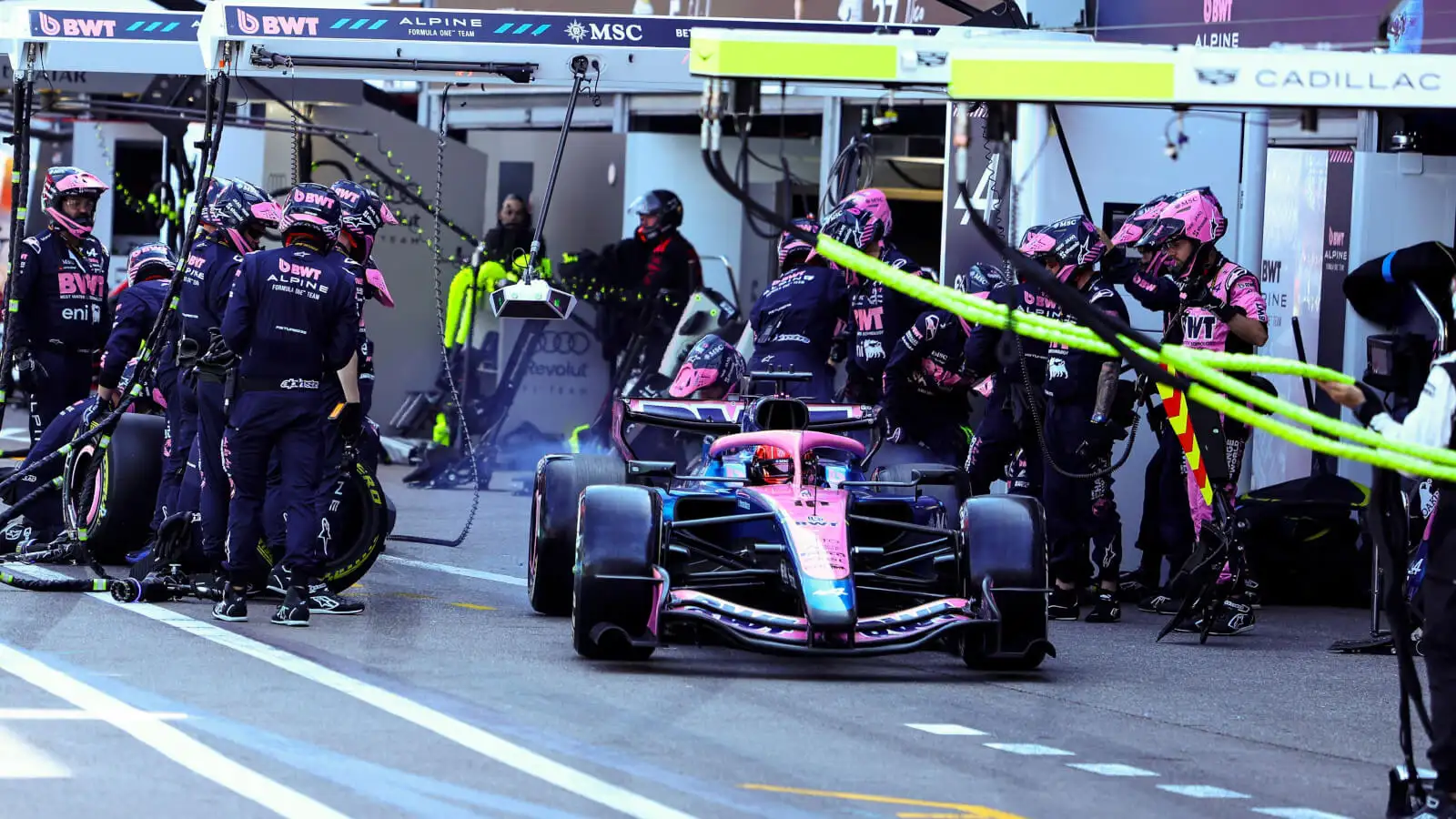
Why Pierre Gasly lost his Monaco podium after the FIA court ruling
The FIA’s International Court of Appeal has overturned Pierre Gasly’s Monaco Grand Prix rescinded time penalties, meaning the French driver has lost his podium.
Three months on from claiming third in Monte Carlo, Pierre Gasly has been demoted back to seventh after his initially rescinded time penalties have been reinstated, meaning Red Bull’s Isack Hadjar takes the podium place.
Why Pierre Gasly was stripped of his Monaco podium
With Gasly finishing third on the road in June’s Monaco Grand Prix, the two time penalties awarded to him for two separate pitlane speeding infringements demoted him to seventh after the chequered flag.
However, Alpine was able to successfully argue that his penalties had been awarded in error, with the stewards being unable to prove that the French driver had actually broken the pitlane speed limit, due to uncertainty created by the positioning of the timing beams.
With six drivers having committed pitlane speeding breaches, five of them served in-race time penalties, but Alpine being able to hold off to serve its penalties for Gasly until the chequered flag meant that it opened the door for the Enstone-based squad to lodge a petition for a right of review – a petition it won.
Successful in getting the stewards to overturn the penalties, reinstating Gasly’s on-the-road third-place, it resulted in more appeals being lodged by McLaren and Red Bull at the International Court of Appeal – these cases were heard behind closed doors in Paris in the week after the Dutch Grand Prix.
The ICA, while elected by the FIA’s General Assembly, operates independently of the governing body, and is the appeal court for motorsport championships under its remit.
On Friday at Monza, the outcome of the appeals were revealed: the two teams were successful in their appeals, meaning the five-second time penalties initially applied to Gasly were re-instated and, as a consequence, he fell back down to seventh as Hadjar was promoted back to third.
The arguments presented by McLaren and Red Bull
The case put forward by the two appealing teams was that the stewards were wrong to have overturned their initial decision to penalise Gasly for the two pitlane speeding infringements.
Alongside the appealing teams and the FIA, who attended with legal teams alongside race team personnel, Racing Bulls also attended the hearing as a third party, while the seven other teams all sent along observers.
In the arena of sporting fairness and equal treatment, the application and serving of penalties by other drivers for the same infringement, regardless of later findings, meant they could argue that Alpine being able to argue its case afterwards created unequal treatment.
FOM’s timing system, which the FIA stewards use for administration and application of the rules, had been used to calibrate the pitlane speed limit, with this limit being calculated on the basis of an average speed based on the length of time to pass between the timing loops at the start and end of the pitlane, rather than being instantaneous.
Alpine’s initially successful appeal was largely won based on the stewards acknowledging that the speed limit regulations do not clearly outline that the official timekeeping process is the sole determination of the limit, meaning it came down to a simple question: Did Gasly exceed the speed limit of 60km/h? In the absence of evidence he did, the penalties were overturned.
However, McLaren and Red bull argued that the timekeeping system is the established calibration against which the teams prepare and, thus, should be the authoritative basis for determination.
It is worth noting that an electronics debrief meeting was held early in the Monaco weekend, which the FIA and team representatives attended; FOM and Alpine were among those who did not, with the FIA’s F1 Electronics Team Leader, Olivier Kieffer, circulating findings to every team that included a general discussion of observed discrepancies in the pit lane speed measurements, and that Mercedes and Williams had raised the fact the timing system findings did not match their own data.
Further arguments included that the pit-lane speed limit exists primarily for safety, and that allowing a competitor to challenge the calculations by way of a retrospective alternative undermined the consistency of safety-focused rules, as well as the reliability and predictability of the FIA’s regulatory systems.
The “standard of proof applicable to the case was not met”, argued the teams, saying that the contentious decision contained “evidentiary errors” and were “insufficient, contradictory, and legally inadequate”.
As an interested third party, Motorsport UK added that, “if not quashed, the Stewards’ Decisions would put national associations in a difficult position as it would imply that an established and accepted official measurement system may be set aside after the event, on the basis of a later and bespoke recalculation advanced by a single competitor.”
Put simply, the argument was that the official timekeeping system should have been the common benchmark all should have competed under and should not have been replaced retrospectively for one competitor.
What was Alpine’s counter-argument?
Perhaps predictably, Alpine’s argument continued to focus on the application of the rule itself, that a breach of the 60km/h speed limit could not be proven, given the uncertainty created by the timing loop inconsistency.
With the regulations not expressly directing that the speed limit can only be measured by way of the official timekeeper, as well as evidence showing that this had used an incorrect distance calculation, as was admitted three months ago, the resulting penalty should be reviewed, argued Alpine.
Alpine’s investigation into the pitlane distances used three methods to challenge the 2692cm distance used by the timekeeping system:
- FOM’s GNSS data;
- Alpine’s own Leica laser measurements; and
- an independent survey by Ridge & Partners LLP.
With FOM’s data showing the relevant minimum distance was 2615cm rather than the 2692cm used by the timekeeping system, Gasly’s recorded times showed that, using the shorter distance, his average speed would have been below 60km/h and therefore, not in breach.
Alpine argued that using the shorter measurement didn’t undermine safety, that it was legitimate to correct an illegitimate penalty regardless of competitor’s statuses, other teams were not treated unequally as they had not sought a right of review (not a regulatory provision, regardless – editor), and that the stewards had sufficient evidence to be satisfied its driver had not breached the rule.
How did the court reach its verdict?
The ICA focused on how the speed limit itself was measured and adjudicated against, rather than questioning the limit itself.
With the official timekeeping using a distance parameter between the timing loops, rather than instantaneous speed, the use of the 2692cm measurement, applied by FOM, was in place for every competitor.
The court emphasised this as a notional calculation input, rather than a physical measurement of the path of each car, with the teams calibrating their pitlane speed limiters using the official timekeeping outputs.
Given that 2692cm was not actually an error in calculation, merely an alternative distance to what was possible given the layout of the pitlane, the court rejected that later geometric analysis of the pitlane could retrospectively overrule the event-wide timekeeping parameter solely for Alpine.
It held that sporting fairness and equal treatment required the 2692cm benchmark, as all other competitors were racing to. This conclusion is grounded in the FIA principles of sporting fairness and equal treatment.
However, the court did not declare the timekeeping system as infallible, saying that the system could be challenged on the evidence of malfunction, incorrect timing, misidentified signals, or other technical errors.
Where Alpine’s case fell apart was the court ruling as impermissible the replacement of the common calibration parameter after the event with a different methodology solely for one competitor.
“Competitors cannot be required to calibrate their cars and make technical and strategic decisions against one official benchmark during the event, only for that benchmark to be retrospectively replaced by a different geometric or measurement methodology after the event has concluded,” the court said.
Gasly’s recorded times of 1.604 and 1.602 seconds also meant that, at an average of exactly 60 km/h, his actual distances would have needed to be approximately 2673 cm and 2670 cm. However, FOM had not measured Gasly’s actual trajectory and couldn’t produce any evidence establishing that he travelled those distances.
Alpine’s reconstruction of Gasly’s trajectory in the pitlane was described by Alpine itself as its “best estimate” and could not be guaranteed to centimetre-level accuracy.
Consequently, it could not establish with sufficient precision that Gasly’s actual path was short enough to prove he was below 60 km/h.
Ultimately, the Court held that the Stewards had erred in setting aside Gasly’s penalties on the basis of the later distance reconstruction.
This resulted in the ICA granting McLaren and Red Bull’s appeals and overturned the two decisions to rescind Gasly’s penalties.
The FIA and Alpine were also ordered to bear the Court costs equally.
What’s next?
Alpine has been left frustrated by the outcome, and PlanetF1.com understands the team is weighing up all its options in light of the outcome, which it disagrees with; other routes and appeals that are available could include an escalation to the Court of Arbitration for Sport.
“The team expresses its disappointment and frustration with the outcome reached by the FIA International Court of Appeal relating to the result of the 2026 Monaco Grand Prix,” said a team spokesperson.
“While we disagree with the decision, and still fully maintain that Car #10 did not exceed the Pit Lane speed limit at any point during the race, the team acknowledges the decision of the judging panel from the recent hearing in Paris.
“While the result is not what we had hoped for, as we feel that we have been unjustly punished, the team is firmly focused on continuing to improve its performance on track and remains in a close and very competitive Championship fight.
“This outcome will not deter the team’s efforts and motivation in achieving its objectives by the end of the season.”
The FIA noted the verdict, saying, “The FIA is reviewing the methodology and operation of the current Formula 1 timing system and the related regulatory matters. It will also be reviewing other judicial procedures and operations including the right of review and the appeal processes.
“The FIA is fully supportive of the Stewarding process and the independence and objectivity of the diverse panels of Stewards who are an integral part of global motorsport.
“Stewards’ decisions are taken in a different environment to that of the Court, whereas the Court has access to extensive and additional legal counsel input, arguments and evidence.
“The FIA Stewards constantly review their processes and take part in extensive professional development. Every decision of the ICA is carefully examined by FIA Stewards ensuring a process of continuous improvement.”
With the next chapter of this ongoing saga now written, it remains to be seen whether Alpine will seek to escalate the matter further, in full belief of its innocence, or whether it will accept the verdict and acknowledge the uniqueness of the scenario that has created the mess.
Want to be the first to know exclusive information from the F1 paddock? Join our broadcast channel on WhatsApp to get the scoop on the latest developments from our team of accredited journalists.
You can also subscribe to the PlanetF1 YouTube channel for exclusive features, hear from our paddock journalists with stories from the heart of Formula 1 and much more!
Read Next: Charles Leclerc sends Monza wild as Ferrari seal 1-2 in FP1