Jakob Ingebrigtsen: not afraid to lose - Athletics Weekly
Athletics Weekly · Athletics Weekly · 2026-09-03T12:20:29+00:00 · nguồn gốc
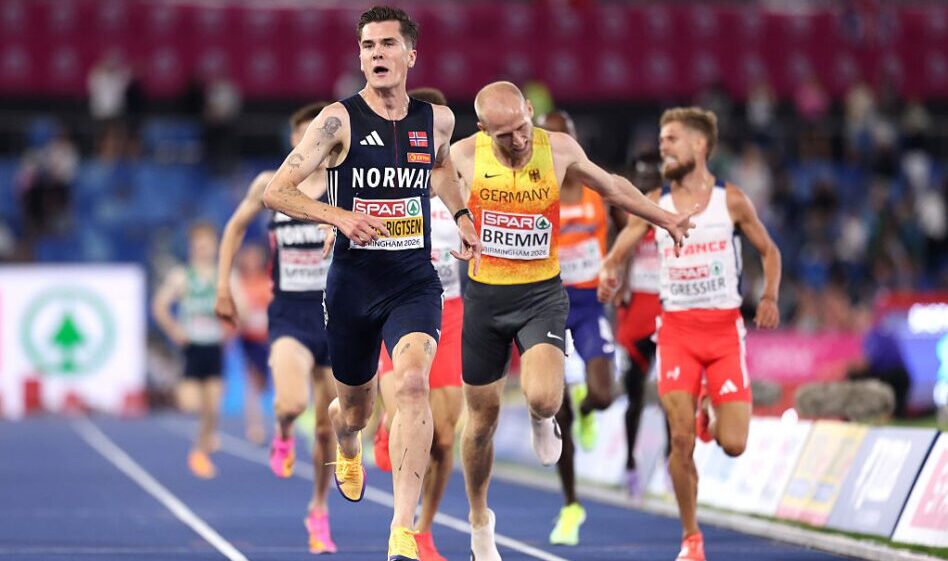
Despite having not competed for 11 months due to injury and surgery, Jakob Ingebrigtsen had no qualms about putting his reputation on the line by racing in Birmingham. Cathal Dennehy examines why showing up no matter what has played such a big part in the Norwegian’s success.
A couple of hours after Jakob Ingebrigtsen had returned to racing, producing a stunning sprint finish to win his fourth straight European 5000m title, the 25-year-old Norwegian was asked a question that went deeper than the usual ones about his race, his health and his comeback. It was about his values, and what this difficult year has shown him on that front.
“A very big and difficult question to answer,” he smiled. “Running is so much. For me, it’s my life and what I’m doing. Working with my team and the people around me, it’s special for us. We want to make the most of it, have a good time and enjoy what we’re doing. Me showing up here and wanting to compete is a big part of it.”
Among the many impressive things about Ingebrigtsen, his ability to show up, come what may, is striking. This has always been his way. Back in 2019, he was an 18-year-old with a huge reputation – already a European senior champion at 1500m and 5000m – and it was well known that track, not cross country, was his true forte.
Yet in March that year, he toed the line for the U20 race at the World Cross Country in Aarhus, Denmark, pitting himself against the world’s best juniors on a course so hilly it was almost sadistic. An abiding memory from the day is Ingebrigtsen lying down in the mixed zone after the race, unable to stand, having run himself to a standstill. He’d been soundly beaten by his East African rivals, coming home 12th – a whopping 47 seconds behind the winner.
The impression was clear: this was an athlete who didn’t care about the knock his reputation might take if he ventured out of his comfort zone and got a sound beating. He knew he’d probably lose, but he had no fear of it. Which is a big reason why he’s won so many titles in the years since.
In Birmingham, Ingebrigtsen was toeing the line in his first race for 11 months, just six months on from the surgery he underwent in California on his Achilles tendon sheath. He knew he wasn’t at his peak, having only done six weeks of proper training before but, just like it was at the Tokyo World Championships last year, he wasn’t afraid to toe the line and find out.
“As long as the [only] risk is to lose, then I’m going to show up and compete,” he said. “When it’s something else, you have the wrong values. This sport needs people to show up, needs people to compete, and it needs everyone to be here, from number one to number five to number 45.”
Ingebrigtsen, of course, finished as number one, having unleashed a 54.94-second last lap and 26.4 last 200m to strike gold – his 17th European senior title across outdoors, indoors and cross country.
“Coming from the lowest of lows to be European champion again means the world to me,” he said. “I doubted myself every day coming into this and every minute leading up to the last lap, but I'm always hoping to do my best.”
The road back had been a difficult one, and many had begun to doubt over the past year whether we’d ever see Ingebrigtsen return to the top. After all, his older brothers Filip and Henrik had both peaked in the first half of their twenties and had been unable to replicate that form in the years after due to injuries.
Jakob had struggled with his right Achilles tendon in the winter of 2023-24, but in 2025 it was his left one that gave him bother, flaring up soon after his 1500m-3000m double at the World Indoors.
Surgery was presented as an option in April last year but Ingebrigtsen chose the conservative route, hoping to make it to Tokyo. He was a shadow of his former self at the World Championships, though – knocked out in the 1500m heats and finishing 10th in the 5000m final.
After another flare-up in his left Achilles at the start of this year, he chose to go under the knife, explaining on his YouTube channel that while the tendon itself was actually fine, the sheath around it was “ruined” and “covered in scar tissue, which is what we have gone in and removed.”
Having pushed the envelope in his return from injury in 2025, Ingebrigtsen was adamant that he’d put his health first in 2026, returning to racing only when his body was 100 per cent healthy – even if his fitness was below that.
“I’m fully recovered from my surgery,” he said in Birmingham. “Now it’s all about fitness and building again. These things, you can always work out. Worst-case scenario, I’m not winning or medalling. I can live with that.”
Three weeks before the race, he was still not back up to his usual training volume and intensity, but each day brought him closer to it.
“That mountain, or tower, may be a little torn down right now,” he said of his fitness. “It's about taking a step back and not doing so many exciting things. Rather, bring it down to the simple, good, old things that you know work and don't have as much risk, and then it will come back.”
He’d been through the wringer physically in 2026, which often sent his mind to a dark place.
“Being an athlete, struggling with injuries, the mental situation is very much reflecting the physical situation and me being sidelined for one half-year, of course I’m not a nice person to be around,” he admitted. “I’m always struggling with getting back into myself and getting healthy again. But as soon as I’m starting to feel good again, then I’m a nice person, so it’s very much correlated. Being a professional runner my whole life, if I feel good in training, I’m good mentally.”
In the 5000m final, Ingebrigtsen adopted a familiar tactic, loitering near the back through the first 3000m before announcing himself at the front with four laps to run, showing the first flashes of his old self when extending a hand to Jimmy Gressier with just over three laps remaining.
For much of his career, Ingebrigtsen would wind it up from the front over the last few laps but this time he chose to sit in and wait, turning into the home straight only third.
“There was a headwind on the back straight so I thought: ‘I’m not in a position to do more than I have to,’” he said. “These are the best runners in the world so I had to make everything count, make my move decisive and spend my energy as perfectly as I possibly could.”
He did just that, only moving off the inside rail with 80 metres to run and then blowing past Gressier and Germany’s Florian Bremm to take gold, his last 100m covered in a blazing 12.6.
When asked about his kick, Ingebrigtsen – a proponent of high volume and double threshold training – made an interesting point. “It doesn’t matter how much speed you have if you’re tired,” he said. “I’ve been trying the last three weeks to not be so tired. Usually, the least tired or fatigued runner wins the 5000m.”
What percentage of his peak fitness had he returned to?
“I can’t be too far off, can I?” he smiled, “considering the amount of talent I’m racing against. These are the best runners in the world. Maybe 88 per cent, 92 per cent. But these last percentages can be very tiny in numbers and tenths of a second.”
In an interview with the BBC the next day, Ingebrigtsen was asked about the absence of Josh Kerr, who bypassed the event after setting a mile world record and winning the Commonwealth Games title in the weeks before – the Scottish star believing that he’d be “flying close to the sun” with injury if he also competed in Birmingham.
Ingebrigtsen complimented Kerr’s world record – calling it an “extremely good race” – but said he was “very” disappointed by him skipping the event. Kerr’s absence was in-keeping with his approach to the event, however. The 28-year-old has never raced at a senior European Championships, indoors or outdoors, though he was a European U-20 champion in 2015.
“I think a lot of people should be [disappointed] because that is what championships are all about,” said Ingebrigtsen. “We have these championships for a reason, and that is for the best athletes to compete – that is the whole point. So I definitely think it is ruining the sport if we are not participating. We all have different plans, but I could never see myself in that position.”
The not-so-subtle dig at his arch rival was proof that Ingebrigtsen is back to his old self – the fast-running, big-talking star who, like Kerr, always carries a main-character energy to the track. First Europe, now the world. In one race, Ingebrigtsen had flipped the script on his season, and maybe his career.
With his health restored, and his training back to its usual level, expect him to close this season with strong showings on the circuit and at the World Athletics Ultimate Championships in Budapest.
“Now I can train properly and from here on, I’m going to be a lot better,” he said. “Astonishingly a lot better. So I’m looking forward to that.”