Why 49ers rookie De’Zhaun Stribling refuses to see himself as a star: ‘I’m just a man’
San Francisco Chronicle · Noah Furtado; Staff Writer · 2026-09-03T11:44:24+00:00 · nguồn gốc
When it was time to welcome her son home, Aisha Johnson asked him to host a football camp for the local boys. She was so proud of him. Everyone was. He had done what people from Hawaii often struggle to do: He made it off the rock.
De’Zhaun Stribling was born at Kapiolani hospital, in the heart of Honolulu, on the island of Oahu, and spent most of his formative years in Kapolei with his mom’s side of the family at the hip. His dad, Karlos, was in the Marine Corps, and so De’Zhaun got a glimpse of the mainland, between assignments in North Carolina, San Diego and Florida, before he returned to Hawaii in the fifth grade. Aisha, who grew up on Oahu and whose dad also served in the military, felt he would benefit from staying put for a bit. She remembered attending a nearby elementary school with the intermediate around the corner and the high school right next to it, surrounded by cousins, aunties and uncles.
She wanted that for De’Zhaun. “We’re a regular local family,” Aisha told the Chronicle. “Everybody’s always together.”
Advertisement
Article continues below this ad
Close-knit extended families are common there. Everyone knows everyone. Leaving that comfort zone can prove challenging, even for someone with Stribling’s ambition, too big for the confines of a volcanic landmass in the Pacific Ocean.
The summer before the San Francisco 49ers made him their top 2026 draft pick, Stribling was not ready to have a camp with his name on it. He still visited his old stomping grounds in Kapolei to talk to the team, at the request of his former high school coach Darren Hernandez, before heading to Ole Miss for his final collegiate season. But no camp.
He wanted to do it the right way. Aisha interpreted his hesitation for sheer humility.
Advertisement
Article continues below this ad
“It kind of comes off as him saying … ‘What’s so good about me? What do they want to know? Why would someone want to hear from me?’” Aisha said. “And even now, I just want to shake him. Like, just do it. People are gonna love you.”
Stribling has since warmed up to the idea. Probably next summer, he predicted, after his rookie year. A standout training camp and similarly impressive preseason have people eager to crown him the next great 49ers receiver. He would probably tell them he hasn’t done anything. Aisha has never understood that thinking. It has always made sense to him. He might just be a perfect fit for his new hard-to-please head coach.
“At the end of the day, I’m just a man,” Stribling said.
Far from home
The closest mainland state to Hawaii is California. It takes five-plus hours to fly there. Stribling declared at age 10 he would play in the NFL. Any such future would mean being at least that far from his family.
Advertisement
Article continues below this ad
Aisha and Karlos watched a number of his teammates make the leap for college ball, only to fall homesick, hurrying back after a semester or two.
Stribling received his first scholarship offer from the University of Hawaii at Mānoa, the state university, following his junior season. He could have easily played for the home team in front of family and friends, certainly an ideal scenario for his mom, who was perhaps a bit biased. “I’m a local girl,” Aisha said. “If we be honest, what we really want in life is just to stay in Hawaii forever.”
She understood, though. In hindsight, Stribling sounded adamant about leaving. UH-Mānoa has not produced an NFL draft pick since 2020.
“Hawaii is great,” Stribling said, “but kind of limits the opportunities.”
He wanted to see what was out there for him, and his parents wanted to insulate him from homesickness. A couple of other FBS scholarships trickled in before he graduated, but he took a gap year. He eventually landed in Pullman. Pullman, Wash. It snows there.
Advertisement
Article continues below this ad
What could have been a cold plunge for Stribling was actually not so bad. Karlos moved with him. Aisha, working remotely, flew up every month. And it also helped that the Washington State head coach who recruited him, Nick Rolovich, was the same Hawaii head coach who gave him his first scholarship offer. Stribling found himself among a cohort of homegrown Hawaiian talent. “It was like we were just sending him off to UH,” Aisha said.
Stribling played two seasons at Washington State, spent another couple of years at Oklahoma State and ended his collegiate career with a season at Ole Miss, where he starred for a College Football Playoff team. The transfers were “business decisions” of his, as Aisha put it.
“When he came in, he was very businesslike,” said George McDonald, the Ole Miss wide receiver coach at the time. “He knew what he wanted to accomplish.”
Aisha realized he was all grown up by then, a far cry from the 5-foot-nothing high school freshman who loved to surf and play kendama, a Japanese skill toy that was all the rage at Hawaii recesses during the mid-2010s. Stribling curbed the surfing habit for obvious reasons. He still owns a few kendamas.
Advertisement
Article continues below this ad
Shanahan’s tough love
Stribling did more than just last a semester or two on his own. After the 49ers selected him No. 33 overall with their first pick in April, the Kyle Shanahan school of tough love was waiting for him. Shanahan has a reputation, fair or not, for being toughest on young wideouts. Stribling was no exception.
Asked about a couple of touchdowns Stribling caught in a joint practice against the Chargers, Shanahan brought up his bad reps. “Those were two good plays,” Shanahan said. “I think he had a couple rough ones, too, so I’ll hold my opinion until I really see the tape.”
The preseason was Stribling’s playground, piling up 11 catches for 109 yards across two games with limited snaps. Shanahan fielded a question about whether he felt the rookie was ahead of schedule. “No, the preseason games don’t mean that much to me and the coverages just went that way,” Shanahan said. “He happened to get targeted, he made those plays, but he’s been doing that in practice, too.”
Stribling was coming back from hamstring tightness earlier in training camp. “We need to get him ready to play an NFL game, and it takes a while for rookies to do that,” Shanahan said. “That’s why a lot aren’t ready for Week 1.”
Shanahan hoped the availability of Ricky Pearsall, a third-year receiver who had shown promise when healthy, meant Stribling would not have to assume a starting role immediately. A wide receiver’s role in the 49ers’ offense can be demanding for newbies. Then an abrupt season-ending knee surgery for Pearsall created higher stakes for Stribling, with an apparent need to play more snaps sooner than expected.
Playing under Shanahan calls for humility. Stribling seems to have a lot of that already.
“There’s no ego at all,” tenured 49ers tight end George Kittle said on Stribling. “One thing I love that Kyle does, he goes like, hey, in front of the whole team … he will build you up and he’ll also point out your flaws. … Strib didn’t take offense to that.”
Humility and pride
It was his freshman season at Kapolei. The junior varsity team had a big game against powerhouse Kahuku on the schedule. But Stribling could not play. He was benched for bad grades. Aisha did not recall much reaction from him.
Sitting in a silent shock, he just listened to her lecture. Summer school was a certainty. “I kind of just remember it not being all fun and games anymore,” Stribling said.
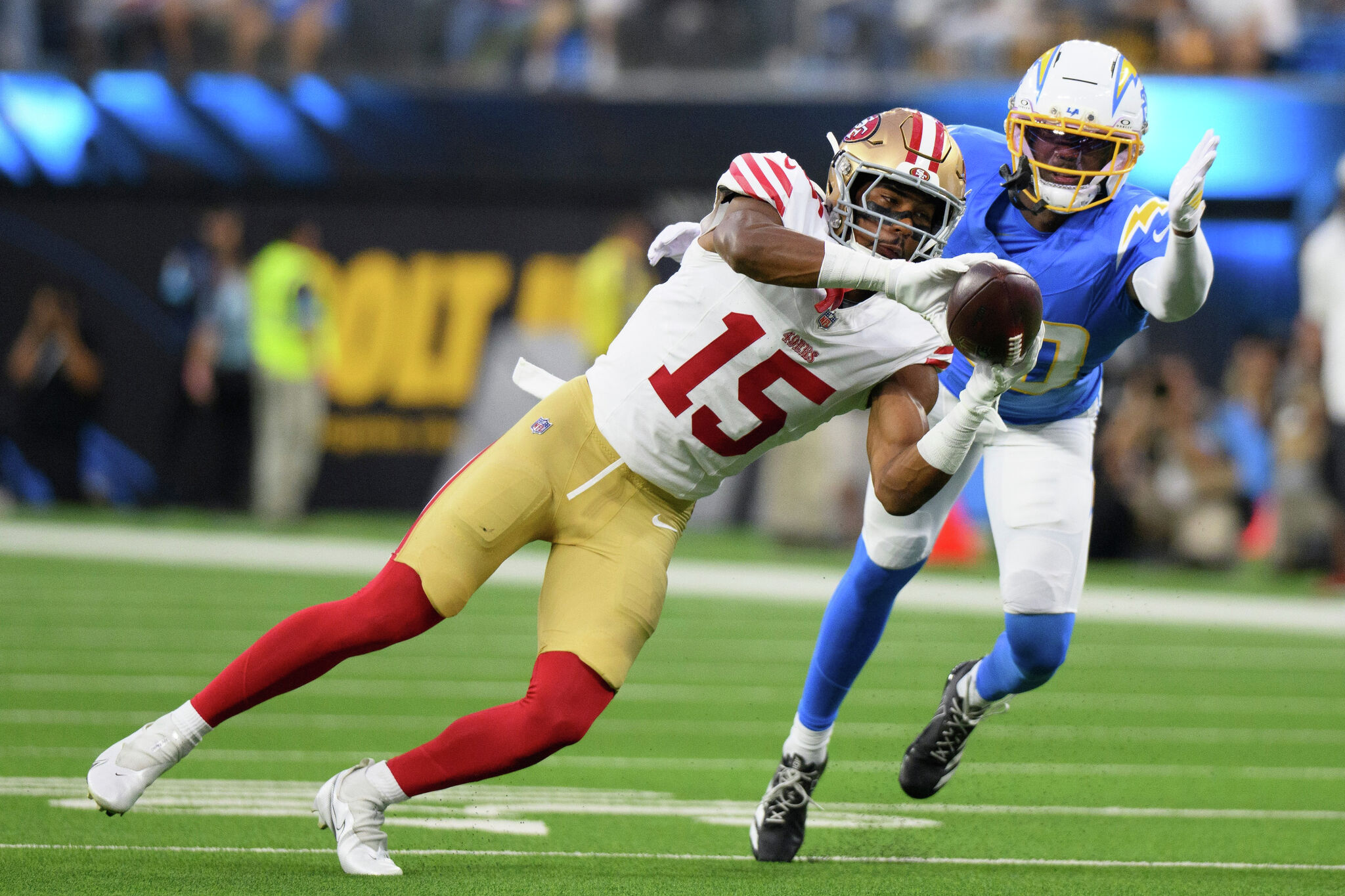
A late bloomer in more ways than one, the now 6-foot-2, 200-plus-pound receiver was not tall enough to clear Hernandez’s armpit when his coach stated he could play in college. It was the kind of belief Stribling did not fully subscribe to until his breakout junior season, accompanied by a growth spurt, a priorities shift and a prized number. “All our best players get No. 7,” Hernandez said. Stribling recently switched from No. 15 to No. 7 with the 49ers, a nod to where this all started.
His dad had modeled sacrifice during his 17 years as a Marine, and his mom grew tougher on him as the prospect of a college scholarship became more realistic. Football was his ticket.
“Everything I’ve experienced and everything that I have gotten in my life is because of football,” Stribling said. “Leaving Hawaii, going to different schools, traveling around seeing different cities, playing in different stadiums … I take (football) very seriously because of what it’s given me.”
Some players like the attention success brings. Stribling, his mom attested, would rather avoid it. He never wanted to be a role model or leader in the “rah-rah” mold. If his example was worth following, then fine.
“He doesn’t want to have to mouthpiece it to say, ‘This is who I am,’” Aisha said.
An athlete’s why can be revealing. Aisha never asked him what his was. “I always just assumed,” she said. “I don’t like the assumption I have. I just assumed it was that he wants to make his family proud.” What’s wrong with that? “I always tell him I’m proud of him,” she answered. “I’m proud of you. ‘Haven’t done anything yet.’ I’m proud of you. ‘Haven’t done anything yet.’”
There’s a Hawaiian pidgin term for a person of Portuguese descent: podagee. Locally, it’s often an endearing way of identifying someone who talks a lot. Stribling seems more soft-spoken, unless he is with those who know him well enough to know he is a podagee, too. Aisha joked that her own “podagee moments” should be stricken from the record. One thing she hoped would be included was where her son was born.
Online sleuthing led her to one article that said Stribling was a North Carolina native. Indeed, his old player profile on the Washington State athletics website mistakenly noted that he originated from North Carolina.
Hawaii is a place with equal parts humility and pride. Its success stories never truly leave.
“I understand the whole business part of everything — and the entertainment — so I really do play my part in that,” said Stribling, adjusting to the higher profile of being a 49ers player. “But at the end of the day, it doesn’t change the way I act, walk, or talk, you know what I mean? At the end of the day, I remind myself that I’m just, just a man.”