Utah Jazz Projected Lineup And Rotation: Dark Horse To Make A Postseason Run? - Fadeaway World
Fadeaway World · Fran Leiva · 2026-09-02T20:08:40+00:00 · nguồn gốc
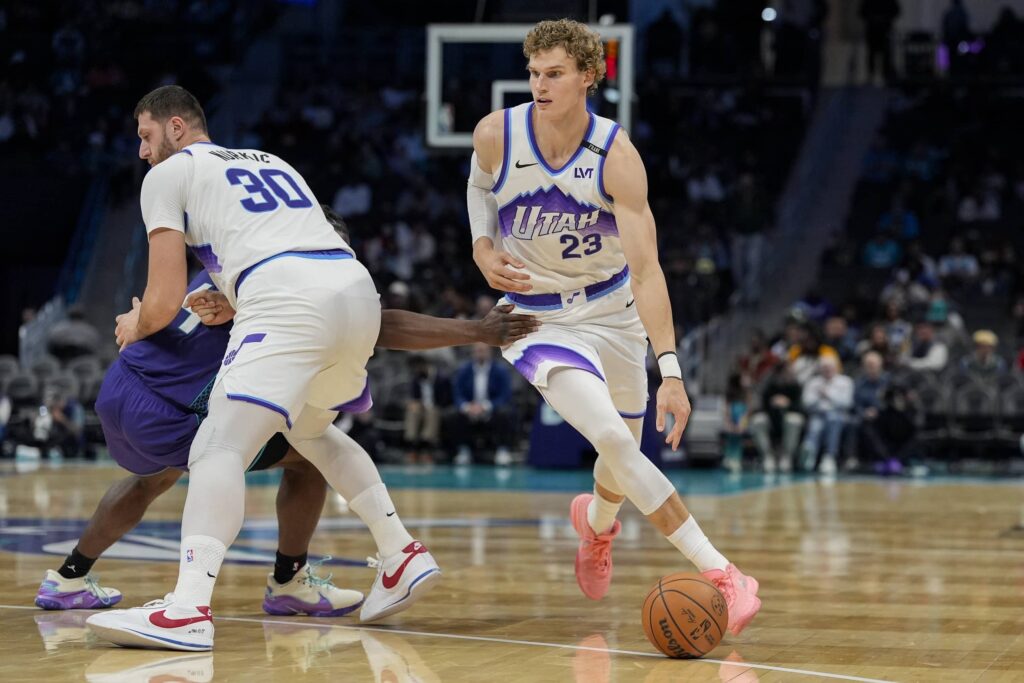
There’s a new sensation with the Utah Jazz finally looking ready to stop living at the bottom of the Western Conference. After winning just 17 games in 2024-25 and inching up to 22-60 last season, this roster suddenly has a lot more NBA talent, and for the first time in a while, Will Hardy has enough pieces to build a rotation ready to start winning while still developing new pieces.
The big shift actually started before the offseason even began. Utah traded three future first-round picks and a handful of players for Jaren Jackson Jr. at the deadline, pairing a former Defensive Player of the Year with Lauri Markkanen. Jackson only got three games in before needing left knee surgery, but the move made it pretty clear the franchise wasn’t planning to keep tanking.
Then came Darryn Peterson. Utah landed the No. 2 pick in the 2026 draft and grabbed arguably the best scoring guard in the class after he averaged 20.2 points at Kansas. They also flipped Walker Kessler to the Lakers for two unprotected firsts and two swaps, brought Jusuf Nurkic back, signed Jaxson Hayes and Josh Okogie, and just traded Cody Williams and John Konchar for Josh Green. That’s a ton of movement for a team that won 22 games.
Nobody should suddenly start calling the Jazz a contender, especially in this version of the West, but the roster’s suddenly deep now. They’ve got scoring, size, young guards, three-point shooting, and Jackson gives them the defensive centerpiece they desperately needed after finishing 29th in defensive rating last season and trading Kessler after it. So could they actually sneak into the postseason conversation?
Starting Lineup
Point Guard: Keyonte George
Shooting Guard: Darryn Peterson
Small Forward: Lauri Markkanen
Power Forward: Jaren Jackson Jr.
Center: Jusuf Nurkic
The first thing that jumps out here is honestly just how enormous this lineup is. George is 6-foot-4, Peterson’s 6-foot-6, Markkanen’s 7-foot-1, Jackson’s 6-foot-10, and Nurkic checks in at 6-foot-11. There aren’t going to be many starting fives around the league with this much size at basically every spot, and Hardy can play with that in a lot of different ways.
Keyonte George earned his spot as the lead guard after a genuinely massive third-year jump. He averaged 23.6 points, 3.7 rebounds, and 6.1 assists in 54 games, shooting 45.6% from the field and 37.1% from three. That’s a huge leap from his first two years, especially since efficiency was always the question mark with him. He went from a young guard just chucking shots on a bad team to somebody who actually looked capable of running a real NBA offense and becoming an All-Star for a good team.
Now he’s getting Peterson right next to him, which should make his job a whole lot easier. Peterson averaged 20.2 points, 4.2 rebounds, and 1.6 assists at Kansas while shooting 38.2% from three, and he already looked way too comfortable at Summer League. Across five games, the rookie put up 23.0 points, 3.2 rebounds, and 5.2 assists, including a 28-point outing in his very first Summer League appearance. He’s only 19, so obviously there’ll be rough nights, turnovers, and bad shot selection mixed in, but the talent is very real.
Honestly, I like starting him right away instead of making him wait behind their main guard. Utah didn’t take Peterson second overall just to watch him play 18 minutes a night, and George has already shown he can operate both on and off the ball. Peterson runs pick-and-roll, George attacks closeouts or spots up, and either one can take over ball-handling duties when the other sits.
Then you get to Markkanen, and this is where the offense starts looking a little ridiculous on paper. He averaged 26.7 points, 6.9 rebounds, and 2.1 assists last season while shooting 47.7% from the field, 35.5% from three, and 89.6% from the line. He only played 42 games, but whenever he was actually out there, he looked like the same elite scorer he’s been since arriving in Utah.
Playing Markkanen at small forward is a genuinely big deal, literally. He can shoot right over smaller wings, punish switches, cut behind Peterson and George, and he doesn’t need to hold the ball forever to get to 25 points. Utah can run him off screens like a guard, use him as a pick-and-pop threat, or just leave him on the weak side while Peterson attacks downhill. There aren’t many 7-footers who create spacing like that.
Jackson’s probably the guy who decides whether this whole lineup actually works. He averaged 19.4 points, 5.7 rebounds, and 2.0 assists last season while shooting 35.7% from three, but the real value is still on defense. He’s already won Defensive Player of the Year, led the league in blocks twice, and made three All-Defensive teams. Utah desperately needed that kind of anchor after giving up 122.3 points per 100 possessions last season, second-worst in the entire league.
There’s one important question mark, though. Jackson’s knee needs to hold up after that post-trade surgery back in February. He only got three games with Utah before his season basically ended, so this season’s going to feel like his real debut with the team in a lot of ways.
Nurkic rounds out the five and gives them a completely different center than what Kessler used to provide. Many outlets project the Jazz to start Nurkic next season, but I’m not too sure about it. Personally? I’d put Ace Bailey at the small forward spot and slide Markkanen and Jackson inside.
But if Nurk ends up starting as the Kessler replacement, he averaged 10.9 points, 10.2 rebounds, and 4.8 assists in 41 games. The passing is really what makes him interesting here. Surrounded by George, Peterson, Markkanen, and Jackson, Nurkic can just catch it at the elbow and actually pass to cutters instead of only screening and rolling.
This starting five could genuinely score a ton. The concern’s pretty obvious too, though. George isn’t a great defender, Peterson’s a rookie, Markkanen’s not someone you want chasing quick wings around, and Nurkic can struggle defending in space. Jackson might spend half his nights cleaning up everyone else’s mistakes. Still, compared to last year, the talent gap is massive.
Main Bench
Point Guard: Isaiah Collier
Shooting Guard: Ace Bailey
Small Forward: Brice Sensabaugh
Power Forward: Kyle Filipowski
Center: Jaxson Hayes
This is honestly where Utah gets really interesting for me, because this isn’t the bench of a rebuilding team at all. There are four young guys here who already proved their worth last season, plus Jaxson Hayes, who’s got seven years of NBA experience and just came out of a Lakers rotation.
Isaiah Collier’s basically perfect as the backup point guard, even if the shooting’s still waiting to develop. He averaged 11.7 points, 2.5 rebounds, and 7.2 assists last season while shooting 49.5% from the field but only 27.0% from three. Seven assists a night at 21 years old is genuinely legit. He gets downhill, creates easy looks for teammates, and can run a second unit without forcing Peterson or George into 38 minutes every single night.
The problem is fit. You probably don’t want Collier logging huge minutes next to Hayes since neither one really spaces the floor, and a lineup of Collier, Bailey, Sensabaugh, Filipowski, and Hayes could get pretty cramped if Bailey and Filipowski aren’t hitting shots. But as a pure backup guard, Collier’s already way better than what most teams have at that spot.
Bailey’s the fun part here, honestly. He averaged 13.8 points, 4.2 rebounds, and 1.8 assists in 72 games as a rookie, starting 61 of them while shooting 34.4% from three. His shot selection was still very much rookie-level at times, but a 6-foot-8 wing who can rise over defenders, score from all three levels, and already give you close to 14 points a night at just 19 years old is a pretty ridiculous sixth-man option to have.
And I wouldn’t get too caught up on him technically coming off the bench either. Bailey could easily close games, slide into the starting lineup if someone gets hurt, or eventually just win a starting job outright depending on how the season plays out. Utah suddenly has the good kind of problem where there are more talented guys than actual starting spots.
Brice Sensabaugh might be even more ready to score right away. He quietly averaged 14.9 points, 3.1 rebounds, and 1.9 assists in only 23.5 minutes last season, shooting 46.0% from the field and 36.7% from three. Nobody really talks about him because, well, Utah lost 60 games and nobody outside the state was staying up late for those box scores, but 14.9 points in under 24 minutes a night is great bench production.
Sensabaugh can check in and basically start firing right away, which this second unit’s going to need. Collier’s more of a creator than a scorer, Bailey’s still going to have inconsistent nights, and Hayes isn’t giving them anything from the post. Having one guy who can randomly drop 15 in 18 minutes is genuinely valuable.
Kyle Filipowski’s another guy who feels kind of overlooked simply because of the team he played for. He averaged 11.4 points, 7.2 rebounds, and 2.6 assists across 77 games, starting 41 of them, and his skill level at 6-foot-11 gives Hardy another way to run offense through a big man. His three-point shot dipped to 32.5%, but he shot 35.0% as a rookie, so there’s at least enough history there to make defenses think twice about ignoring him.
He can also slot in next to either Jackson or Nurkic depending on the matchup. Against smaller teams, Filipowski at center speeds them up. Against bigger teams, playing him at power forward adds another rebounder and passer without completely killing the spacing.
Hayes is the last piece in all this. He averaged 7.5 points and 4.1 rebounds in 66 games for the Lakers last season while shooting 75.6% from the field, then signed a two-year, $12.0 million deal with Utah. He runs, jumps, catches lobs, blocks the occasional shot, and plays his role. That’s plenty for a backup center.
Additional Depth
Josh Okogie
Svi Mykhailiuk
Josh Green
Josh Okogie isn’t going to score much, but he gives Hardy a genuine defensive option whenever the starting guards are getting cooked. He played 78 games for the Rockets last season and averaged just 4.5 points and 2.6 rebounds, but he also shot a career-best 38.5% from three. If that shooting holds up anywhere close to that level, his two-year, $12.0 million deal could end up being a real bargain.
Svi Mykhailiuk’s basically the opposite case. You play him when you specifically need shooting. He averaged 9.4 points last season and hit 40.8% from three in 50 games for Utah, so leaving him outside the main ten-man rotation says a lot about how much deeper this roster has gotten.
And then there’s Josh Green, who literally just joined the team days ago. Utah sent Cody Williams and John Konchar to Minnesota for Green and some cash, adding another 6-foot-6 wing who’s already played on winning teams before. Green’s role last year was nonexistent at just 4.3 points in 58 games, but he shot 42.0% from three and is a career 38.7% shooter from deep.
Green probably gets rotation minutes somewhere, but I honestly don’t know whose minutes you’d actually take. That’s a good problem for Hardy to have, though. Okogie brings defense, Svi brings shooting, Green brings a bit of both, and all three can step in if the younger wings hit a rough patch.
Are The Jazz A Dark Horse To Make A Postseason Run?
I wouldn’t go crazy and call Utah a playoff lock or anything like that. They were 22-60 last season, finished 15th in the West, had the league’s 29th-ranked defense, and their -8.2 net rating was 27th overall. You don’t normally jump from that to a top-six seed in a single summer.
But this also isn’t really the same team anymore, not even close. Jackson barely played after the trade, Peterson wasn’t even here yet, Markkanen only played 42 games, and Utah also swapped out some of last year’s random depth to favor their own young players, who got another year of NBA seasoning under their belts.
The offense could honestly be really good. George and Markkanen already combined for 50.3 points a night last season, Jackson adds another 19.4 on top of that, and Peterson was one of the best scoring prospects in the entire draft class. Utah scored 117.6 points a game last season even while being a genuinely bad offensive team by efficiency, partly because they played at the third-fastest pace in basketball. Add this much shot creation into that same pace, and there could be some wild scoring nights ahead.
Defense is really where the whole postseason conversation lives or dies. Jackson can erase a lot on his own, but one guy can’t single-handedly turn the league’s second-worst defense into a good one. Peterson needs to survive his rookie year, George needs to keep improving on that end, Nurkic can’t get attacked every single possession, and Hardy will probably lean on Okogie or Green more than this projected rotation even suggests.
Still, I can absolutely picture Utah being right in the middle of the Play-In race this year. There’s just too much talent here for another 20-win season if the main guys stay reasonably healthy, and the depth is probably better than most people realize right now. A normal playoff spot feels like a stretch at this point, but being alive for the No. 9 or No. 10 seed deep into March? That genuinely isn’t crazy to imagine.
For the first time in years, Utah might actually be trying to win basketball games, and more importantly, they finally have enough good players to make that pursuit genuinely interesting.