A tip, an iPhone photo and a scoop: How Kaepernick’s protest exploded in one frantic night
San Francisco Chronicle · Eric Branch; Staff Writer · 2026-09-01T11:05:45+00:00 · nguồn gốc
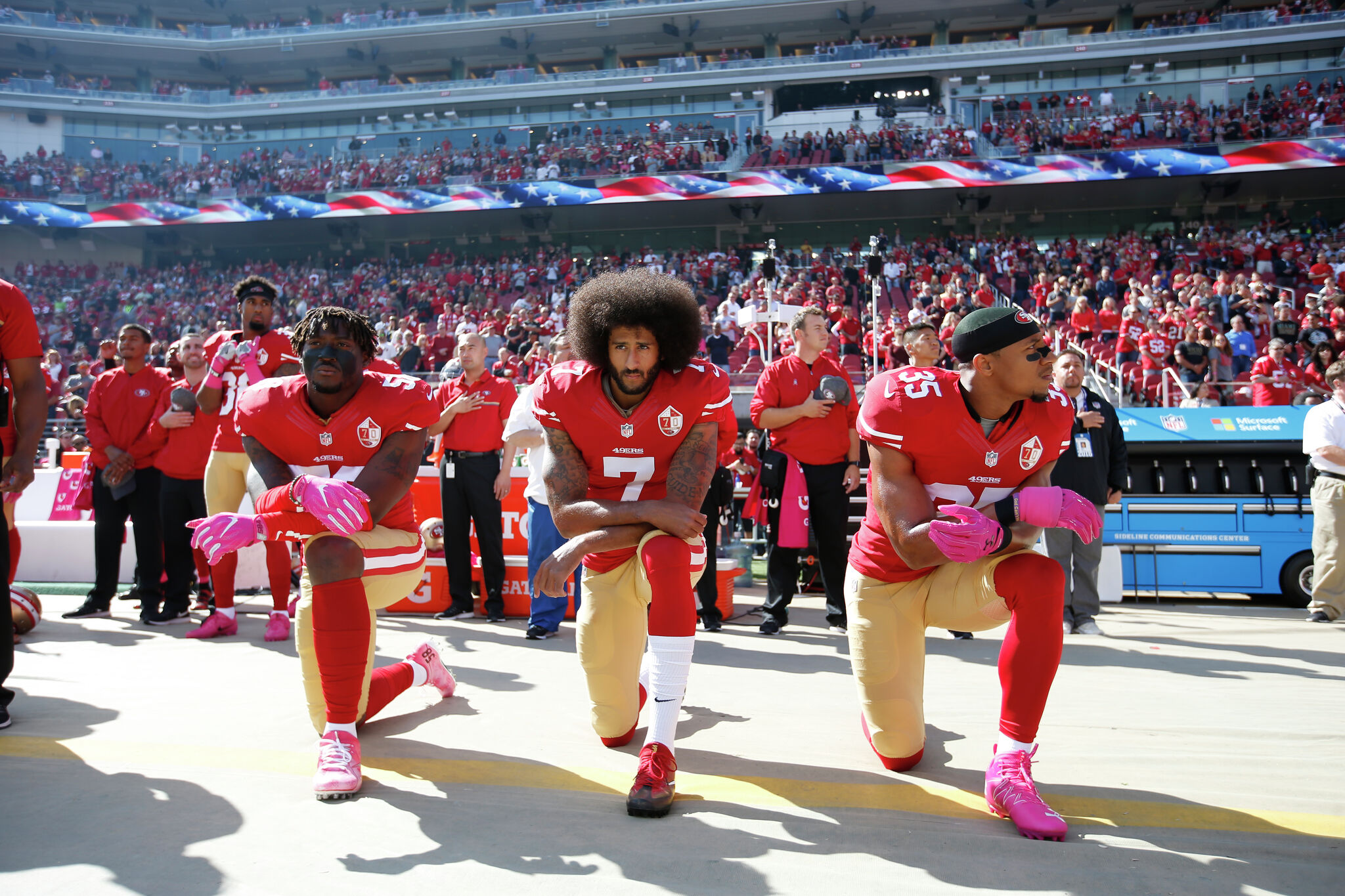
Mike Garafolo had the tip. Jennifer Lee Chan had the click. Soon, Steve Wyche had the story.
At 7:02 p.m. on Aug. 26, 2016, around the same time Garafolo was relaying information to Wyche, his NFL Media colleague, Chan, unknowingly, snapped a historic iPhone photo three minutes before kickoff: It’s the only known picture of San Francisco 49ers quarterback Colin Kaepernick sitting, rather than kneeling, during the national anthem.
Garafolo had just called Wyche in the moments before the 49ers’ third preseason game against the Packers at Levi’s Stadium. He told Wyche, who was in the press box, that a source had shared that he thought Kaepernick didn’t stand for the anthem during the 49ers’ first two exhibition games.
Advertisement
Article continues below this ad
Garafolo saw Chan’s social-media picture of players standing for the anthem. The players were dots, but Garafolo knew what he was looking for. He could make out Kaepernick, sitting between two orange Gatorade coolers. Confirmation.
He called Wyche, who hadn’t located the well-concealed Kaepernick from his nosebleed perch until he saw him emerge, standing near the coolers. He must have been sitting? Garafolo’s call erased any doubt.
Wyche had a scoop.
Advertisement
Article continues below this ad
“In my head, I’m like, ‘Oh, s—, this is going to be big,” Wyche said.
Chan, then at SB Nation, had a surprise. She didn’t realize what image she’d captured until she returned home that night.
“It was like, ‘Holy crap,’” Chan said.
They had no idea. No one did.
“I knew it was going to be big,” Garafolo said. “I didn’t think it was going to be as big as it got.”
Advertisement
Article continues below this ad
Ten years after Kaepernick took a stand by taking a seat — and then a knee — there is debate about his legacy in a country that’s become even more polarized. There are also questions about why more modern-day pro athletes haven’t taken a cue from Kaepernick and taken controversial stands.
But there’s no debating this: The early days were wild in what became the biggest story connecting sports and society in the 21st century.
The morning after the preseason game, Wyche’s story was published: “Colin Kaepernick Explains Why He Sat During National Anthem.” Explained Kaepernick: “I am not going to stand up to show pride in a flag for a country that oppresses Black people and people of color.”
“It became a wildfire pretty quick,” said Dan Beckler, a former 49ers public relations staffer who handled Kaepernick’s interview requests. “When this happened, it opened up the idea that, ‘OK, this is outside of sports.’”
Advertisement
Article continues below this ad
The 49ers were quickly besieged by newspapers, websites — and international outlets that didn’t know a first down from a touchdown: the BBC. Le Parisien. Die Zeit. Al Jazeera. All weighed in. Soon, so did outgoing President Barack Obama and soon-to-be President Donald Trump. Time Magazine revealed Kaepernick would be on its cover.
Two days after the preseason game against the Packers, Kaepernick addressed reporters for the first time in the locker room, speaking passionately about the killings of Black people by white police officers. After sitting through three anthems without anyone noticing, he was surprised to learn that he had become headline news on CNN.
Racism. Power. Privilege. Patriotism. Police brutality. The cannon-armed QB had unleashed something shockingly powerful.
“It wasn’t something that I really planned as far as it blowing up,” Kaepernick told the media throng before ensuring it would only get bigger by also weighing in on, among other topics, the presidential election: “You have Hillary (Clinton) who has called Black teens or Black kids super predators. You have Donald Trump who’s openly racist.”
- ‘Government made sports a political event’: How national anthem became stage for protest
- A tip, an iPhone photo and a scoop: How Kaepernick’s protest exploded in one frantic night
- Ann Killion: Colin Kaepernick’s era of sports activism ‘vanished with him.’ Another is coming
- How A’s catcher Bruce Maxwell brought taking a knee to MLB and what happened afterwards
- Bay Area sports’ defining moments in march toward social justice
Advertisement
Article continues below this ad
Three days later, a controversial picture surfaced. It had been taken three weeks earlier, when Kaepernick wore socks to practice depicting police officers as cartoon pigs. A day later, the San Francisco police officers’ union ripped Kaepernick in a statement.
It added fuel to the national debate. Kaepernick was a multimillionaire athlete with the courage of his convictions, risking it all. Or he was an anti-American traitor and police hater.
Against that backdrop, Kaepernick played in his first game since his protest became public on Sept. 1, when the 49ers visited the Chargers in their preseason finale in San Diego.
Team photographer Michael Zagaris stayed near Kaepernick as the team left the locker room. A phalanx of photographers greeted the quarterback when he emerged from the tunnel. It was “Salute to the Military” night in a military town. Navy SEALS parachuted into the stadium. A Navy petty officer was about to sing the national anthem. An oversize American flag covered most of the field. There were boos. And worse.
“Oh, yeah, there were people yelling some s—,” Zagaris said. “It was blowing up, a really huge deal. It was obvious I’d be shooting history.”
Zagaris was right. A photo he took from that night is displayed in the National Museum of African American History and Culture in Washington, D.C. A photo from later that season landed on the Time cover.
On Sept. 1, Zagaris estimates he snapped 15 anthem photos of Kaepernick and teammate Eric Reid, who had joined the protest, kneeling on the sideline as Zagaris knelt in front of them and Nate Boyer, a former Green Beret. Boyer, who is white, was standing next to Kaepernick with his right hand over his heart.
At one point, Zagaris sprawled on the ground and shot upward. He then ran behind the bench to capture the scene from the rear.
Should professional athletes use their positions of fame to speak out in the form of protest or activism? Tell us why or why not.
It's been a decade since Colin Kaepernick took a knee during the national anthem, essentially ending his NFL career. Tell us your thoughts on athlete activism.
“I was trying to see what works,” Zagaris said. “I thought, even if it never happens again, this is a moment in time.”
The moment became reality after Kaepernick, Reid and Boyer met at the Westin Hotel in San Diego’s Gaslamp Quarter hours before kickoff. After the meeting, Kaepernick and Reid decided to take a knee during the anthem — a posture they viewed as more respectful to members of the military.
It was a significant moment in a historic protest. And it took place in the hotel lobby, with guests checking in, others walking by and pedestrians craning their necks.
“There were people walking by the windows from outside taking selfies with Colin in the background,” Boyer said. “He had the Afro, was all over the news and was already so recognizable. But most people didn’t come within 10 feet of us. They kept a respectful distance.”
Boyer became part of the story because of his unique perspective: He’d spent time in fatigues and a football uniform. At 29, after his military service, he played organized football for the first time when he walked on at Texas. He spent three seasons as the Longhorns long snapper and played a preseason game with the Seahawks in 2015.
After Boyer penned a respectful open letter to Kaepernick that was published by Army Times, he said Kaepernick’s agency reached out to request a meeting. The agency paid for Boyer’s Uber ride from Los Angeles to San Diego.
Boyer has been credited for advising Kaepernick to take a knee. But he’s aware that Kaepernick has a different version of events in his upcoming memoir, “The Perilous Fight,” which will be released Sept. 15. In 2016, during his news conference after the preseason finale, Kaepernick invoked the “long conversation” he and Reid had with Boyer when asked about why he decided to kneel during the anthem.
“As we talked about it, we came up with taking a knee,” Kaepernick said, adding it was a “way to show more respect for the men and women that fight for this country.”
Boyer said in a recent interview that they talked for roughly an hour about how changing the protest could keep the focus on Kaepernick and Reid’s message rather than their method. Boyer noted people take a knee when praying or proposing. Athletes take a knee when another player suffers a serious injury.
“I remember Colin and Eric kind of like nodding and looking at each other,” Boyer said. “They may have had a discussion about this before. Maybe they already had this in their head that that was something they were going to do. I don’t know what was said before I met them. I just remember our conversation and that they made the decision to kneel together.”
Kaepernick and Reid were joined by linebacker Eli Harold in their protest during the regular season. Beyond that weekly shared unity, however, Zagaris recalls that Kaepernick often wore headphones and appeared isolated from teammates. But Beckler had a different perspective.
Beckler presented Kaepernick’s endless requests for exclusive interviews to him, with Kaepernick declining them all. They often spoke in Beckler’s office, or at Kaepernick’s locker.
They had worked together since Kaepernick’s rookie season in 2011. They navigated the Super Bowl media storm in Kaepernick’s breakout second season. They were in Kaepernick’s hometown of Turlock in 2013 for a Sports Illustrated story.
However, their last season together in 2016 — which would ultimately be Kaepernick’s last in the NFL — was the most meaningful. Beckler gained a deeper understanding of the biracial adopted son of white parents who grew up in the Central Valley.
“I’m never going to have been in those shoes — I’m never going to understand what that’s like,” Beckler said. “And so I always wanted to give Kap the opportunity just to be himself. He literally was opening up his heart through this demonstration, and was super vulnerable with issues that he’s dealt with growing up. And we had more conversations behind closed doors about real-life stuff.”
The national conversation was far different. And it began the morning after that night in late August when Wyche spoke privately with Kaepernick outside the auditorium at Levi’s Stadium. After their 10-minute conversation was over Wyche, then 50, said he told Kaepernick, then 28, what was about to happen.
“I’m just letting you know right now, this is going to be a very big story, Colin,” Wyche said.
Replied Kaepernick: “Hey, it is what it is.”
They had no idea. No one did.