Open Scoring in MMA: How It Works, Where It Is Used, Tradeoffs Explained | MiddleEasy
MiddleEasy · Jake Blend · 2026-08-29T13:42:25+00:00 · nguồn gốc
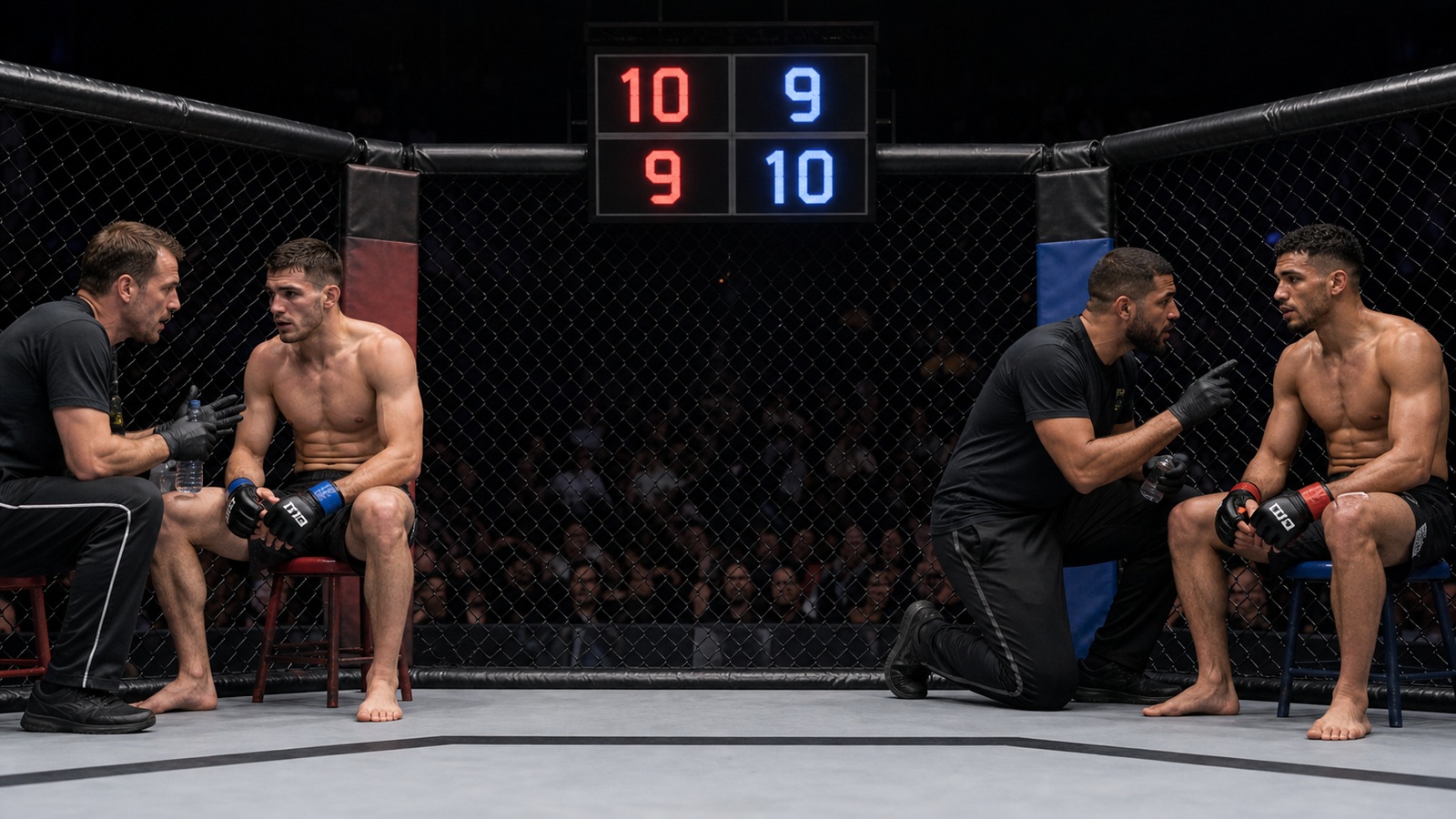
Open scoring in MMA means the judges still score each round under the normal rules, but their numbers are disclosed before the fight is over. Depending on the commission and event, the reveal may go to the corners, the arena, the broadcast audience, or all three after a completed nonfinal round.
That new information can change a corner’s advice and a fighter’s risk calculation. It does not rewrite the 10-Point Must System, correct a weak scorecard, or guarantee a more exciting final round. The clearest way to understand the debate is to separate three questions: how a round is judged, when the score is released, and what each fighter does with it.
Open scoring changes disclosure, not the scoring criteria
The Association of Boxing Commissions and Combative Sports says a minimum of three judges evaluate an MMA bout. Each judge scores every round independently, normally giving 10 points to the round winner and nine or fewer to the other fighter. A rare even round can be 10-10.
Effective striking and grappling come first. Effective aggression matters only when the primary criterion is even, followed by control of the fighting area if the first two levels still do not separate the fighters. The ABC’s 2025 clarification further organizes a judge’s evaluation around damage, dominance, and duration.
Readers who need the underlying criteria first can use MiddleEasy’s full guide to MMA’s 10-Point Must scoring system. Open scoring sits on top of that process. The judge records the same 10-9, 10-8, or other appropriate score; the difference is that the card does not remain completely hidden until the final announcement.
How open scoring works during a three-round fight
The exact delivery method is set by the regulator and event. A practical three-round version usually follows five steps:
- The judges score Round 1. Each judge submits an individual card to the scorekeeper. The judges should not confer.
- The regulator collects and checks the cards. The scorekeeper confirms the numbers and applies any referee point deduction under the governing procedure.
- The scores are released under the approved format. A commission representative may show them to both corners, while an arena screen or broadcast graphic may also display them.
- Round 2 is scored independently. A judge should evaluate only the action in that round, even though fighters and spectators may now know the first-round cards.
- The process repeats before the final round. After the bout ends, the complete totals produce the official decision in the usual way.
The phrase open scorecard can sound like one running number, but there are three judges. One fighter could lead 20-18 on two cards after two rounds while the third card is 19-19. That split matters more than a single unofficial broadcast total.
A 20-18 lead changes the math
Suppose the blue-corner fighter trails 20-18 on two official cards entering Round 3. Winning the last round 10-9 would still leave those cards at 29-28 for the red corner. Blue likely needs a finish, a legitimate 10-8 round, or a point deduction to avoid losing both of those cards.
If the cards are 19-19, a normal final-round win can decide the fight. If each judge has a different total, the corner has to interpret three possible paths rather than react to one headline number. Open scoring provides real information, but it does not make the tactical answer automatic.
Where open scoring has been used in MMA
There is no single worldwide MMA regulator. In the United States, a state or tribal commission controls the rules and procedures for events in its jurisdiction. A commission can authorize open scoring without requiring every promoter to use it, and a promoter may want the format in one place but be unable to use it elsewhere.
| Jurisdiction or promotion | Documented use | What the example shows |
|---|---|---|
| Kansas | The Kansas Athletic Commission authorized real-time MMA scoring in 2020. Invicta FC and LFA events supplied the early data. | A commission can approve the procedure while promotions choose whether to use it. |
| Colorado | Colorado adopted an open-scoring option for boxing and MMA in 2021. | Availability at the regulatory level does not mean every sanctioned bout uses it. |
| Invicta FC | Invicta introduced open scoring at Phoenix Series 3 in Kansas and continued using it at eligible events. | Corners can make decisions from official cards instead of guesses. |
| LFA | LFA cards in Kansas formed part of the commission’s early comparison data. | Repeated events allow regulators to compare fight outcomes before and after adoption, though the samples are observational. |
| Oktagon MMA | Oktagon announced promotion-wide use beginning with Oktagon 51 in December 2023, with scores shown to corners, the crowd, and viewers. | A promotion can make the reveal part of its viewing product where local rules permit it. |
This is a set of documented examples, not a permanent global directory. Commission policies, event locations, and promoter choices change. Viewers should check the event’s rules rather than assume a promotion always uses the same disclosure procedure.
Why supporters want fighters to know the score
A corner can solve the actual problem
Under closed scoring, a corner can read the fight well and still guess the official cards incorrectly. Open scoring replaces part of that uncertainty with the numbers that will decide the bout if it reaches the distance.
A fighter who is ahead can protect the positions and exchanges that produced the lead without confusing urgency for effectiveness. A fighter who is behind can decide whether a higher-risk route is justified. That was central to Henry Cejudo’s case for open scoring: athletes would know when the cards require a stronger response.
It exposes a strange card before the result
Early disclosure also makes a surprising round visible while the event is still happening. That can improve transparency, but it cannot repair the score. Judges are still expected to score later rounds independently, and no angry arena reaction should replace the official criteria.
The trailing fighter gets a truthful risk signal
A fighter down two rounds may need a finish, but the right route depends on skill and position. A strong grappler should not abandon takedowns simply because a knockout is faster. A striker should not rush through a reckless exchange when sustained pressure can still create a clean finish. The score identifies the problem; the corner still has to choose a credible solution.
The strongest objection is late-round disengagement
The most familiar argument against open scoring is simple: a fighter who knows they are safely ahead may spend the final round avoiding exchanges. Dana White has argued that visible scores could produce bad third rounds by giving the leader a reason to protect the advantage.
That outcome is possible in an individual bout, but three limits matter. First, a trailing opponent now knows that conservative work is not enough and can increase pressure. Second, deliberate avoidance can lose a round and, at an extreme, MMA rules identify timidity as a foul. Third, the available data does not show systematic disengagement by leaders.
What the research finds
A 2025 peer-reviewed Journal of Sports Analytics study by sports economist Paul Gift examined whether knowledge of a likely score changes final-round behavior. The analysis used known scorecards and performance data from 3,646 UFC bouts over seven and a half years to model fights in which the outcome entering Round 3 was relatively certain or genuinely ambiguous.
The study did not find evidence that leading fighters systematically stopped engaging. In the author’s public summary, fighters with a likely lead won the final round about 10.4% more often. The clearer behavioral shift came from the trailing side: takedown-attempt rate fell by 38% and submission-attempt rate fell by 49%, consistent with fighters moving toward a knockout route.
Those findings need a careful label. The UFC did not use open scoring in those bouts. The study used outcome certainty as an observational proxy, so it cannot reproduce every psychological and crowd effect of an official reveal. Kansas also published descriptive results from Invicta and LFA events, but promoters opted into the procedure and the early samples were limited. Together, the evidence weakens the universal coasting claim; it does not prove that every open-scored final round will be aggressive.
Open scoring creates tradeoffs beyond coasting
Public reaction can become new pressure on judges
If scores appear on an arena screen, a crowd can react before the next round. Judges should ignore that response, yet the possibility of influence is a real design concern. Laura Sanko raised that issue after working events with the format, arguing that audience reaction could affect a judge’s later work.
A regulator can reduce that risk by limiting the reveal to corners or by improving physical and procedural isolation for officials. That choice creates another tradeoff: corner-only disclosure helps the athletes but gives spectators less transparency.
Bad information arrives earlier
An inaccurate 10-9 is still inaccurate when everyone sees it one minute later. The reveal may let the disadvantaged fighter react, but it does not retrain the judge, revise the criteria, add a fourth scorecard, or provide an appeal during the bout.
Open scoring is therefore a disclosure reform, not a complete judging reform. Better education, consistent rule adoption, official accountability, and scorecard review are separate questions.
Strategy can become less varied
A fighter who knows a finish is required may narrow the game too sharply. The study’s reduction in takedown and submission attempts among trailing fighters illustrates that risk. Chasing one kind of finish can make offense easier to predict and can remove a credible threat that previously created striking openings.
The leading fighter faces the opposite problem. Protecting a lead can be rational, but passivity can concede the round or allow the opponent to build momentum. Good corner advice should translate the cards into specific actions, not merely tell one fighter to run and the other to swing harder.
Five open-scoring misconceptions to discard
- It does not replace the 10-Point Must System. The criteria and numerical round scores remain the foundation.
- It does not guarantee correct judging. Transparency can expose disagreement without resolving it.
- It does not announce the winner early. A finish, point deduction, 10-8 round, or divergent card can still change the result.
- It is not automatically a UFC rule. U.S. athletic commissions regulate events, and the UFC has not adopted it as a standard format.
- It is not one identical procedure everywhere. Corners, spectators, and broadcasters may receive different levels of access under different approvals.
Use this viewing checklist when scores are revealed
- Read all three cards, not only the broadcast’s combined graphic.
- Check whether a point deduction changed the running total.
- Separate a 19-19 fight from a 20-18 deficit; the required final round is different.
- Remember that a 10-8 can rescue a card that a 10-9 cannot.
- Watch whether the trailing fighter abandons a productive skill or increases pressure through the same game.
- Judge the next round on its own action, not on whether the earlier cards matched your score.
Open scoring gives fighters and viewers a clearer map before the destination is fixed. Its best case is informed adaptation and transparent stakes. Its limits are just as important: the map can still be wrong, the reveal can create new pressure, and better information does not choose the right tactic. Treat it as one targeted reform to the timing of information, not a cure for every problem in MMA judging.