Exit, Wing Left
The Non-Negotiables · Sham · 2026-08-27T14:29:53+00:00 · nguồn gốc
For the last several years, my wife and I have watched every season of The Great British Baking Show. It started during the COVID-19 pandemic — like everyone else, we needed an escape from the constant horrors of that time (sadly, not much has changed six years later). Bake Off presented something undeniably uplifting: a selection of quaint and jolly British folk, assembled in a pristine tent full of top-of-the-line culinary equipment in a faraway clearing, tasked with baking fancy desserts for judges who looked like the students’ favorite professors at Hogwarts. The whole premise oozed whimsy.
Sure, there was a competitive element. But every contestant on the show seemed inherently instilled with a sense of altruism; not only is there a welcome lack of subterfuge or underhandedness, but bakers were actively willing to assist each other when they could. It was lighthearted, happy entertainment that reminded us of the goodness out there in the world, at time when some of us who desperately needed it.
I’ve learned two things from Bake Off. First, the understanding of Mexican cuisine by the general UK population is woefully inadequate. The air date for the show’s “Mexican Week” episode is one that will live forever in infamy. Some of the pronunciations I heard in that edition of the show continue to haunt me to this day. “Gacky-molo.” “Pico de gallio.” Do better, Brits.
My other takeaway from the show has to do with the reality of what it is: a contest, a winner-takes-all battle royale. Unfortunately and inevitably, people have to lose. And losers have to depart.
Which is all well and good to begin with. For the first episode or two, we barely know these contestants. It doesn’t sting all that much to witness the dismissal of some random person you just met a matter of minutes ago. You can empathize with the fact that no one likes to be deemed worst of the bunch, but it is what it is. No skin off your nose.
But then the weeks go by. You zero in on a few contestants you identify with for one reason or another. Maybe you feel represented by them. Maybe you’re blown away by some of their bakes. Perhaps you admire them after learning their story or you just like the cut of their jib. What’s clear is, you don’t want to say goodbye to them.
Sometimes you luck out and you end up developing that parasocial relationship with a contestant who at least makes it to the final day of the season. But usually, your favorite baker isn’t the best one in that tent. And after the contestants who are clearly out of their depth depart, that baker’s standing feels more and more precarious every week. They’ll make mistakes like underproofing their dough or failing to let fillings cool before adding them to a pastry. Sometimes they’ll simply have a poor showing throughout the entirety of the episode.
And whenever they do that, a quiet dread creeps into the front of your brain. Is this it? Is this finally the day when your favorite gets sent home? Will you finally have to sit there and watch as the person you rooted so enthusiastically for is told they’re no longer good enough to stay? Is this how the journey ends, with one of the hosts saying with love in their eyes that it’s time to leave?
Because deep down, you know they’re on the chopping block. On a cellular level, you can’t deny that your champion will be unable outrun the bear forever. And that’s okay. You don’t love them because they’re the best. You love them because they are who they are.
Eventually, that day does come for all but three Bake Off hopefuls (and two of those finalists lose out in the end anyway). And that day has now come for Gabriel Martinelli.
He arrived at Arsenal seven years ago a kid from Ituano, a club that played in the third tier of Brazilian football. Still a teenager, Martinelli was initially slated to begin with the Gunners’ U21 team. But such was the evident ability of the youngster that Unai Emery immediately promoted him to the first team. In a squad full of aging and content veterans on bloated wages, the winger’s boisterous pace and directness stood out massively.
Emery’s successor clearly agreed. After the Spaniard was sacked, Mikel Arteta took over and deployed Martinelli as soon as he returned from a hamstring injury. Under Arteta the Brazilian initially flourished and became a regular starter in the side, quickly overtaking Hale End product Emile Smith Rowe on the left flank.
And with good reason — Martinelli exhibited many traits of an elite forward. He was almost always the fastest player on the pitch, possessing game-breaking speed that consistently kept high lines honest. The Brazilian was typically one of the best finishers in the side too, which was great because he was also something of a shot monster, particularly in his early years at Arsenal. He was willing to take on his man on the dribble and was a dedicated defender off the ball. From the outset, Martinelli looked like a fortune-altering prospect.
He provided several flashes of that latent talent along the way. In his full Premier League debut, the young forward clinically slotted home to draw the Gunners level with West Ham. Just a few matches into Arteta’s tenure, Martinelli collected the ball from an unsuccessful Chelsea corner and scored a legendary coast-to-coast goal at Stamford Bridge to equalize for ten-man Arsenal. There was the sensational header and sweet far-post finish within the span of two minutes against Standard de Liège in the Europa League. And who could forget the brace at Anfield in the EFL Cup?
Such was his effectiveness that he formed something of a dynamic duo with Saka. The precocious young wingers became a reliable one-two punch for Arsenal as the club attempted to rise from the ashes. Many goals took the form of a back post cross from Saka to Martinelli or a smart cutback by the Brazilian to the Englishman near the penalty spot. The pair looked set to achieve superstardom together. In an ugly present, they represented a bright future.
Saka and Martinelli proved emblematic of the team’s growth in stature over several years. As they went from strength to strength, establishing themselves as two of the best wide players in the Premier League and earning important shirt numbers, Arsenal climbed back up the table. When they finally had a center forward able to properly play off them in Gabriel Jesus, the Gunners’ wingers contributed heavily to a 100-point pace that saw the side mount an unlikely title charge. Probably the only reason it wasn’t ultimately successful was the loss of William Saliba and Takehiro Tomiyasu to season-ending injuries on the same night. During that 2022/23 campaign Martinelli scored 15 goals in the English top flight, tying the record at the time for most goals scored by a Brazilian in a single Premier League season.
But after that, only Saka continued to ascend. In the years since, the Englishman has cemented himself as one of the world’s best wide players. However, Martinelli’s progress has in contrast slowed. Some would say he has stagnated as a player.
Ultimately, I do think there is some unfortunate truth to that conclusion. Once so eager to attempt shots on goal, the Brazilian’s numbers have dropped off in that regard (and accordingly, his goalscoring too). The Martinelli we see now is also a far cry from the 1-v-1 demon who terrorized full backs regularly; he still has that kind of performance in his locker but more often than not, the Brazilian struggles to beat his man consistently. And in a team that strives to reach not only the summit of the English top flight but the pinnacle of European football altogether, his lack of attention to detail can sometimes be painfully apparent. The missed pressing assignment that led to Manchester City’s winner at the Etihad Stadium last season still sits top of mind, as does a glaring miss at Nottingham Forest that helped see the Gunners drop points.
A few years ago, Martinelli’s standing in the squad would have been safe regardless of these issues. But now, the Smith Rowes and Alexandre Lacazettes and Albert Sambi Lokongas and Nuno Tavareses have gone from the squad. The standard, the constant demand for excellence, is the highest it has been in at least two decades and possibly ever. Having so clearly lost the starting job to an older, less athletic Leandro Trossard purely due to the Belgian’s decision-making and penchant for crucial goal involvements, Arsenal’s no. 11 has become the odd man out. As the end of this round of transfers approaches he is on the hot seat, as he has been for some time now.
Perhaps some of the blame should lie with the manager here. After all, it was Arteta’s job to get the best of all his players, including Martinelli. In particular, Arteta’s coaching career took off with his ability to coach up wingers like Raheem Sterling and Leroy Sané. And yet, one could argue that the gaffer never played to the winger’s strengths. Because of how Arsenal has played in recent seasons, Martinelli was often isolated out near the touchline, left to beat his marker with minimal support when it is very arguable that he is a player who does his best work in central positions. Due to injuries and tactical preferences, the players who were around him often were footballers who didn’t mesh well with the Brazilian’s qualities, such as Viktor Gyökeres, Piero Hincapié, and a double pivot of Declan Rice and Martín Zubimendi. Arteta simply did not make things as easy for Martinelli as he could have.
But then again, you can only build around so many players. And Arsenal are not built for a style of play that emphasizes Martinelli’s qualities. Arteta’s philosophy revolves around control, around domination in and out of possession. That’s not the Brazilian’s modus operandi; he is more of a weapon for positive game states, a threat in behind when opponents are chasing the match who can punish high lines. Because of the ever-increasing frequency with which the Gunners now face low blocks, Martinelli’s effectiveness has now become far more situational.
However, do not mistake this for a proclamation that the Brazilian is not a fine footballer. Because although it is time for him to make way, Martinelli leaves behind a legacy. This past season, now his final in north London, he produced plenty of crucial contributions in a campaign that saw Arsenal win the Premier League and reach the Champions League final.
Although he only scored once in the Premier League last season, that sole strike took the form of a late equalizer in which he chipped the ball over a scrambling Gianluigi Donnarumma from a highly impressive distance and angle, snatching a point from City that proved over the subsequent months to make quite a massive difference.
He also assisted another crucial moment in the title race, nodding the ball into Max Dowman’s path following an Everton corner and smartly holding off desperate defenders as the 16-year-old ran the length of the pitch and clinched the points for Arsenal, becoming the youngest goalscorer in Premier League history in the process.
In the Champions League, the Brazilian was Arsenal’s top scorer. He scored and assisted late on in the Gunners’ first league phase match against Athletic Bilbao. Martinelli then went on to find the back of the net in five consecutive appearances, making him the first-ever player in the club’s history to do so.
He put the game to bed against Bayern Munich at the Emirates. At Club Brugge, he matched Noni Madueke’s screamer with one of his own. In the first leg of the quarterfinals, away to Sporting, Martinelli whipped in a luscious ball in the 91st minute to find Kai Havertz in the box with enough space to tuck home the winner of the whole tie.
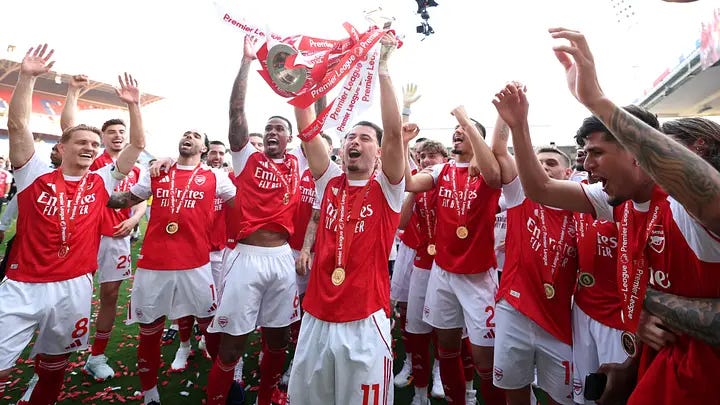
And of course, he ended his last chapter at the club by finally lifting the Premier League trophy.
It’s a high note to leave on. Or at least, it would be if not for the circumstances surrounding his departure. Because it is quite clear at this point that Martinelli was not part of the manager’s plans to begin this new season. He did not even make the bench for either the Community Shield or the league opener against Coventry City, instead being forced to watch from the sidelines in street clothes.
However, look at the team he was left out of. Newcomer Christos Tzolis has been a revelation at left wing — he notched two assists against City in the English Super Cup and absolutely ran the show against Coventry. Then there are the players who occupied the bench across those two games: Hincapié, Saka, Gyökeres, Rice, Zubimendi, Madueke, Dowman, Eberechi Eze, Mikel Merino, and Ethan Nwaneri. Objectively, it’s difficult to see where Martinelli fits without removing important players in other positions.
This is where the Brazilian’s Arsenal story ends. After years of doing enough to make it to another round, of seeing other contestants sent away, Martinelli’s time has come. He has made it as far as he can.
And it is sad. We have watched this player grow over many years. We saw him arrive as a boy from a small club in Brazil. We then watched him score at Stamford Bridge, Anfield, and the Santiago Bernabéu. We bore witness as he beat some of the greatest keepers of his time — Donnarumma, Alisson, Thibaut Courtois, Manuel Neuer, Jan Oblak, and Emi Martínez among them. We read the public adoration from Jürgen Klopp, one of the greatest managers the English top flight has seen. Before our eyes, he has matured into a skilled veteran. It’s tough to say goodbye to someone we have that kind of emotional attachment to. Especially given the upheaval this move will require in their life.
At the time of writing, Martinelli is set to join Al-Hilal of the Saudi Pro League. Reports suggest the fee will come out to between £50 million and £60 million. James Benge of CBS Sports has reported that a medical has been scheduled for this coming weekend. While negotiations between the clubs appear to have been rather straightforward, indications are that the Brazilian was reluctant to agree to the move.
Which I can sympathize with. He married his partner just this summer, and now has to uproot his spouse and family to Saudi Arabia, a country with a significantly different culture to that of Brazil or England. Fortunately, the deal sees Martinelli earn a significant pay raise. Even just a couple seasons with Al-Hilal can offer him generational wealth, which should justify this somewhat burdensome detour in his career.
Admittedly, this exit feels somewhat un-Arsenal. Although, with all due respect to Ian Wright, I highly doubt Martinelli was actually in the dark about his standing at the club; HandOfArsenal reported that Arteta was actually quite direct with him regarding that subject. But still, the ruthlessness with which he has been shown the door is distinctly off-brand for the English champions. After rebuilding such a warm camaraderie between the first team and the fans, you have to wonder about the impact such a relatively forced exit could have on both parties, especially as the Gunners struggle to offload the likes of Jesus, Fábio Vieira, and Reiss Nelson.
Unfortunately, that difficulty with selling only further necessitates Martinelli’s exit. Arsenal need to ensure some outgoings this summer, not just to recoup funds and adhere to their self-sustaining model, but to make room in their squad for both current and new players. When the least desirable footballers on the roster will only fetch small fees and the sale of beloved academy products like Myles Lewis-Skelly and Ethan Nwaneri would trigger angry protests outside the Emirates Stadium, the options become quite limited. The judge that is fate has spoken.
In any event, it is settled. The next stage of Martinelli’s career will begin, and we will have to face life without a player we’ve come to love, who for many of us has always felt like an honorary Hale End graduate. I’ll miss Martinelli for his rapid pace, his ability to produce amazing moments, his endearing seeming innocence (the video of him wishing SpongeBob SquarePants happy birthday has always given me a chuckle), and the obvious love he has for Arsenal Football Club.
In the end, he leaves immortalized as a Premier League champion, with the additional distinction of being one of the initial players to set Arsenal down the path of winning their first title in 22 years. He also departs with an FA Cup and Community Shield under his belt as well. Although his time at this club has come to an end sooner than he and many of us wanted it to, Martinelli nevertheless made it a successful tenure in north London. He did what so many players before him — players like Cesc Fabregas, Alexis Sanchez, Mesut Özil, and Pierre-Endrick Aubameyang — couldn’t, helping the Gunners reach heights they hadn’t been to in two decades. For that, he is undeniably an Arsenal legend.
Thanks for everything, Gabi. All the best moving forward.
If you enjoyed this post, please consider following me on Twitter @Shamsdale or on Bluesky @shamsdale.bsky.social.
Or you can buy me a coffee here.